
#ProgrammaticAds

Why CTV Supply Is Getting Harder to validate
Connected TV has moved past being an experiment on a media plan. Budgets have moved from TV to streaming. Buyers now expect to bid for premium video inventory just as they bid for any programmatic channel. At glance that seems like a simple extension of digital buying into the living room.. Underneath it is becoming one of the toughest validation challenges in the industry. This is a change from how validation works on the open web. A buyer checking a web impression can look at the domain, the page content, the browser and the referrer. None of these signals are perfect. They give traders a familiar and fairly stable frame of reference. CTV replaces that frame with app bundles, device identifiers and content data all of which are declared by participants in the chain instead of being independently confirmed. Declaring something and proving it are two actions and the gap between them is where most risk in programmatic CTV now lies. Part of what makes this gap is the length of the supply chain. A CTV impression rarely travels in a line from a content owner to a demand side platform. It usually goes through a streaming platform, one or more monetisation partners, an exchange and sometimes a reseller before it reaches a buyer. Each extra hop adds a bit of opacity. Two bid requests can look the same when they reach a buyer even though the paths behind them are completely different. One might be publisher supply. The other might have changed hands three or four times. Both can carry OpenRTB fields, which is why supply path analysis has become as important in CTV as it already is in web and app inventory. The identity problem makes this even worse. Web advertising built its targeting and measurement around cookies, browser signals and mobile advertising identifiers. None of that infrastructure works on a television screen. CTV relies on device identifiers, household level signals from measurement partners and IP based information that has its accuracy limits. This creates two questions that are often treated as one. The first question is whether an identifier is syntactically valid. The second and much more important question is whether that identifier represents an in-market viewer. A large pool of device IDs can look like an audience size on a report but it offers no real evidence that a human was watching. Invalid traffic behaves differently in this environment too. A sudden spike in requests from one streaming app is not automatically suspicious because popular CTV apps can generate huge volume on their own. Automated environments are now sophisticated enough to produce requests that look like CTV traffic with plausible device types and content meta data. The old method of flagging one field no longer works well here. What matters more is looking at combinations of signals including request volume, device distribution, geography and historical performance to spot patterns that do not add up instead of chasing a single red flag. The bigger shift in the industry is a change in what counts as an advantage. For years that advantage came from having inventory. Now it will come from being able to answer a narrower question, with confidence: can you prove that the impression being sold is the impression it claims to be? That question will become more important as CTV budgets keep climbing and the platforms that can answer it clearly will be the ones buyers trust with their spend.
Read Article →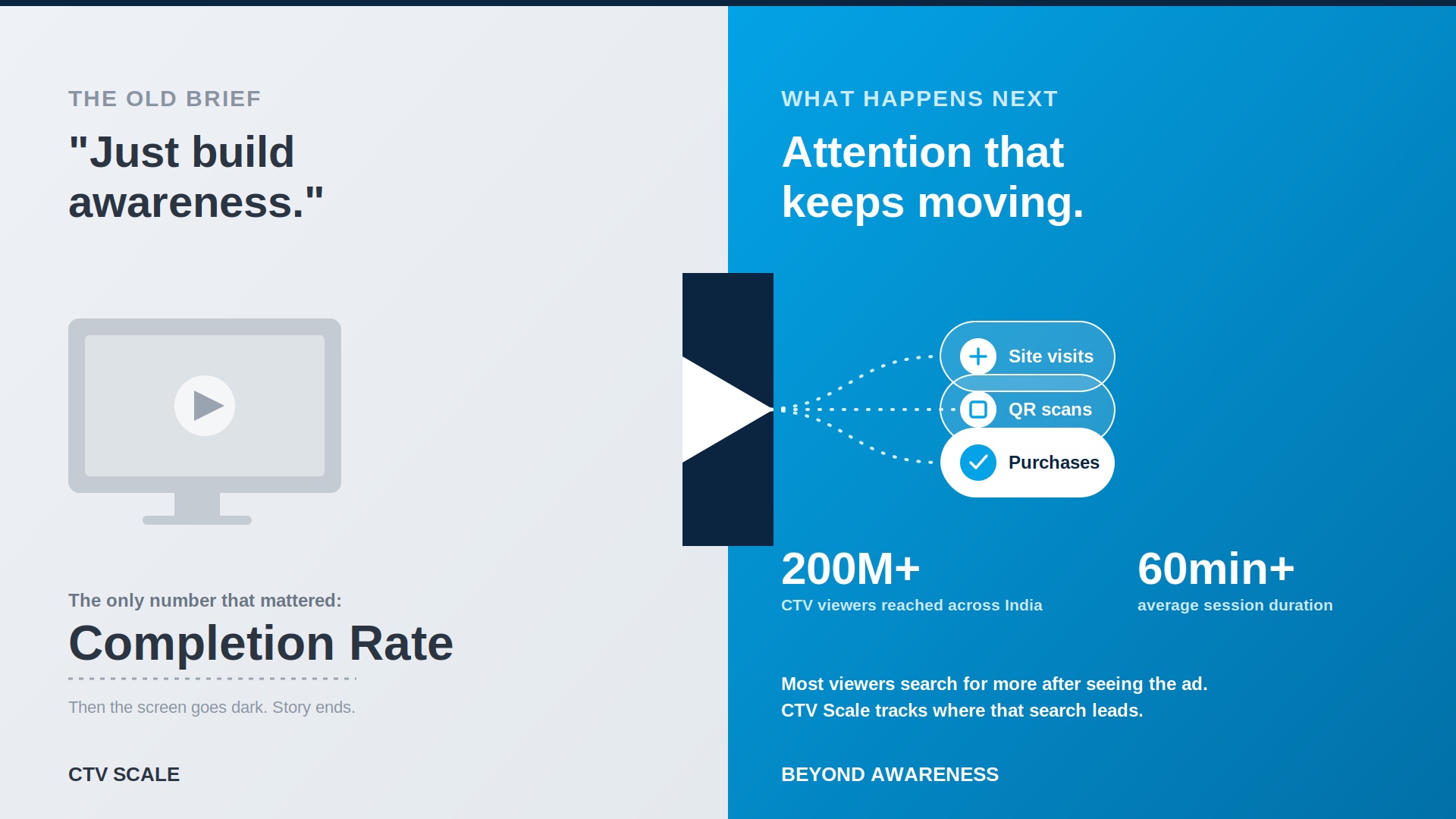
What should advertisers expect from CTV beyond “Awareness”
Connected TV has long been seen as a brand channel in media plans. A campaign would play on the screen, completion rates would look good, and that would be the end of the story. Most people assumed that CTV only built awareness while real business results came from search, social, and performance marketing. That assumption is very much just an assumption not the truth. Advertisers who still plan that way are missing a big part of the channel. The change shows in the numbers. CTV now reaches more than 200 million viewers in over 60 million households in India, almost three times the reach a few years ago. What matters more than size is what people do after seeing an ad. Recent research on Indian CTV viewers found that most viewers look for more information after seeing an ad, and the percentage is even higher among premium audiences. This is a channel where attention does not stop when the ad ends. Attention moves from the living room screen to the phone. Then into search, app stores, and storefronts. The reason CTV was hard to credit with business outcomes for long has less to do with the medium and more to do with measurement. A viewer s action after an ad usually does not happen on the device that showed the ad. Nobody clicks a television. The tools that link what people saw on their TV to what they did later have improved a lot, and deterministic attribution is now closing that gap. Advertisers using CTV Scale can track site visits, app installs, QR scans, and registrations back to campaigns. That means the channel can finally be judged on the same terms as any other performance line item while still keeping the scale and premium context that made it attractive. This changes what advertisers should ask for. A media plan that treats CTV as a reach vehicle reporting only video completion rate asks the channel to prove far less than it can. The useful question is what happens after the impression. Formats like pause ads and QR overlays give viewers a way to act while still watching instead of waiting for a later touchpoint. Shoppable formats shorten the gap between seeing a product on screen and thinking about buying it. Interactive and app sync capabilities let a single campaign report on outcomes from brand lift to app opens in the dashboard. None of this takes away the awareness value of the channel. It sits on top of it, turning one flight into a funnel tool instead of a single-stage tool. There is also an advantage that is underused. Average CTV session durations in India often last more than an hour, giving advertisers high‑attention windows in one sitting, not just one exposure to optimize. Brands that design a sequence taking a viewer from an opening story beat to a mid‑campaign moment to a closing conversion prompt tend to see stronger downstream results than brands that repeat the same thirty‑second film in every slot. Treating CTV as a canvas for a journey rather than a slot to fill is where the mid and lower funnel gains really come from. None of this means awareness stops mattering. Premium, large‑screen storytelling still does something that a six‑second mobile clip cannot copy, and category leaders will keep investing for good reason. What has changed is the ceiling. Advertisers, on CTV Scale, no longer need to choose between brand building and measurable outcomes because the same campaign, designed with intent, can deliver both. The advertisers who will get the most out of CTV in the coming year are the ones who stop asking whether the channel can perform and start asking what to measure once it does.
Read Article →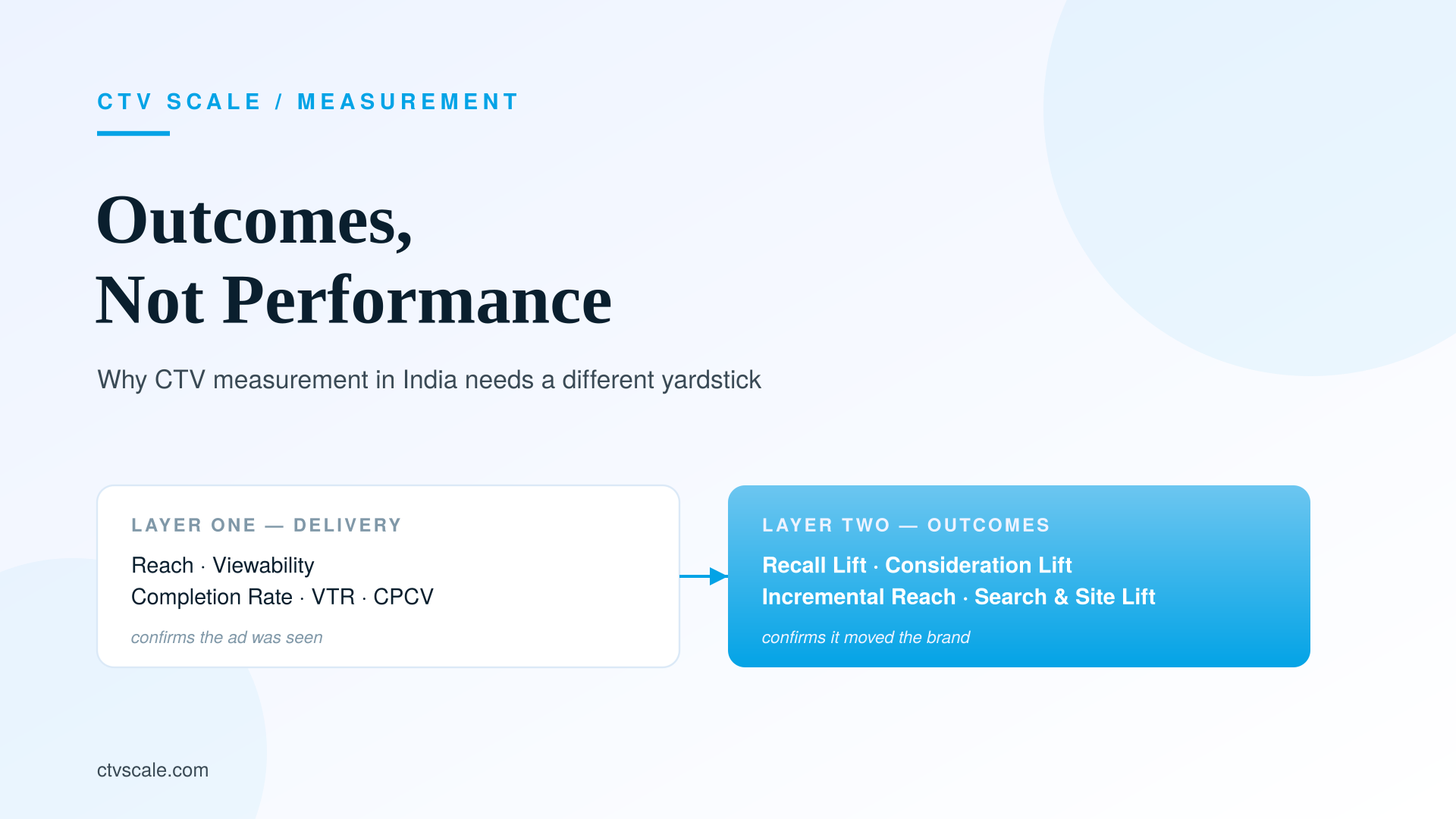
Why CTV Measurement Needs to Talk About Outcomes, Not Performance
Every conversation about Connected TV in India ends up at the same question. Did it work? Advertisers ask their agencies. Agencies ask their platforms. And the platforms answer with the same list of numbers: reach, impressions, viewability, completion rate, VTR, CPCV. These numbers are useful, and no CTV plan should be built without them. But the word usually attached to this list, performance , is the wrong word, and it is causing real confusion. Performance suggests a straight line from someone seeing an ad to their buying something. That idea comes from search and social media, where a click can be tracked all the way to a purchase in the same sitting. CTV does not work like that. Treating it like it does means judging a brand-building channel by rules it was never meant to follow. A better word is outcomes . Outcomes cover what CTV is actually good at: making people consider a brand, helping them remember it, and moving them a step closer to buying, even if that happens three days later on a phone or a laptop. What the Metrics Actually Tell You Reach and impressions tell you how many households the ad reached. Viewability tells you whether people had a real chance to see it, and on CTV, that chance is usually high, since the ad takes over the full screen on platforms like JioHotstar, SonyLIV, ZEE5, and FAST channels, instead of getting lost in a scrolling feed. Completion rate and VTR tell you whether people watched the whole ad or dropped off halfway. CPCV tells you what that attention cost you. None of these numbers tells you whether the campaign actually changed anything for the brand. They tell you the ad was delivered, not what it achieved. Most CTV measurement conversations in India go wrong right here, when a good completion rate gets treated as the end goal. A 95 percent completion rate only tells you people watched. It does not tell you if it made someone move from not knowing the brand to actually considering it. Where the Real Outcomes Show Up The real outcomes of a CTV campaign usually do not show up in the CTV report at all. They show up somewhere else, in numbers that a brand is already tracking. Things like: how many more people searched for the brand name after the ad ran, how much direct traffic came to the website, or how the brand's search share moved on the e-commerce platforms where people actually buy the product. You can also see it in recall studies, where you compare people who saw the ad against a similar group who did not. And you can see it in incrementality studies, which show what CTV added on top of what other channels were already delivering. This takes more effort than glancing at a dashboard. It means being patient and looking at results over days and weeks instead of expecting an instant answer. But it is a fair way to measure a channel that mostly works on brand building rather than instant sales. If a brand runs CTV to build familiarity before a big festive sale, it should not be judged on clicks, because CTV was never meant to generate clicks. It should be judged on whether more people were considering that brand once the festive season started. India's CTV audience is still figuring out its own viewing habits. People are spread across JioHotstar for live sports and entertainment, SonyLIV and ZEE5 for regional shows, and a growing number of FAST channel viewers who behave differently from people who pay for a subscription. Data from BARC keeps showing that this audience is genuinely new, not the same people just watching on a different screen, which is exactly the kind of value that gets missed when you only measure performance. If a brand only looks at last-click conversions, it ends up underselling the value of every new household CTV brings in, simply because those households were never going to buy on day one, no matter which channel reached them. The fact that CTV in India is spread across so many apps and platforms makes this even more important, not less. The big platforms often limit how much advertisers can actually see about who they reached and how often. In a situation like that, chasing one performance number that nobody can measure consistently across platforms is not a smart use of time. It makes much more sense to track outcomes instead: brand lift, incremental reach, and what happens on search and the brand's website in the days after the ad runs. That gives advertisers one clear way to measure results, no matter which platform, publisher, or FAST channel delivered the ad. A Simple Way to Think About It There are really just two layers to CTV measurement. The first layer is delivery . Did the ad reach the right households, did people actually see it, did they watch it? This is where reach, viewability, and completion rate belong, and platforms owe advertisers honest, clear reporting on these numbers. The second layer is outcomes . Did the campaign actually move the brand forward? This is where recall, consideration, incremental reach, and what happens on search and the website afterward all belong. Both layers matter. But only the second layer really answers the question every advertiser is asking when they say they want to know if it worked. Once a brand gets comfortable with that difference and is willing to wait a bit longer for a real answer, it stops questioning its CTV budget every quarter and starts renewing it instead. CTV was built to be a brand channel first. Measuring it by outcomes, instead of performance, is simply measuring it for what it actually is.
Read Article →.jpeg)
Scaling CTV Without Sacrificing Targeting Precision
The rapid migration of viewers from linear broadcasting to Connected TV (CTV) has presented advertisers with a Strategic yet frustrating landscape. While the promise of digital precision on the big screen is the primary draw, the reality often falls short because the industry is still trying to apply mobile-first tracking to a shared household device. As we navigate 2026, achieving true scale in CTV requires a departure from traditional third-party data reliance, which is increasingly fragmented and inaccurate, and a shift toward a strategy that respects the unique nature of the television medium. To scale effectively without diluting your targeting, you must move beyond the missing demographic data of the CTV bid stream and embrace a more sophisticated, content-first approach. 1. Bridging the First-Party Data Gap The foundation of any successful CTV campaign is the shift away from volatile third-party data. In the CTV ecosystem, third-party cookies are nonexistent, and household-level demographic data is often incomplete or outdated. To achieve precision, advertisers must leverage their own first-party data as the North Star. By integrating your CRM data and website visitor insights into the CTV bid stream, you move from guessing who is behind the glass to targeting known entities. This first-party intelligence allows you to build robust lookalike models that find new high-value households based on actual purchase history rather than unreliable third-party proxies, ensuring that every dollar spent on a big screen impression is grounded in verified consumer behavior. 2. Prioritizing Contextual Over Demographic Targeting A significant hurdle in CTV is the shared screen problem: a single device is often used by multiple family members. As a result, individual demographic targeting (such as age or gender) is becoming harder to rely on. Instead of chasing a specific person who might not even be the one holding the remote, advertisers are returning to the strengths of traditional television, which is content-based advertising. By targeting specific genres, shows, or apps that align with your product, you ensure your message reaches a viewer in the right mindset. On CTV, the content being consumed is the most accurate signal of the audience's intent. If they are watching high-end travel documentaries, the context provides more targeting precision than a missing or inaccurate demographic tag ever could. 3. Achieving TV Scale with Digital Accountability To scale CTV, you must treat the platform like a television for reach but like a digital asset for measurement. This means moving toward household-level targeting using IP addresses and device graphs rather than individual user tracking. This approach allows you to achieve massive reach across premium Lean Back environments while maintaining the Lean Forward analytics of digital marketing. By mapping CTV impressions to downstream actions such as a website visit on a laptop or a purchase on a smartphone within the same household, you can prove ROI and optimize your spend in real-time. This dual-pronged strategy ensures you do not need to choose between the broad impact of a TV ad and the surgical precision of a digital campaign. 4. Navigating the Nuances of the CTV Bid Stream Understanding the technical limitations of the CTV bid stream is essential for maintaining precision at scale. Unlike the open web, the CTV environment is a fragmented collection of hardware manufacturers, app developers, and streaming services, each with its own data standards. Because traditional identifiers are often stripped out or missing during the ad request, scaling often leads to wasted spend on low-quality inventory if not managed correctly. By focusing on direct-to-publisher deals or curated private marketplaces (PMPs), advertisers can ensure they are buying high-quality, human-verified impressions. This level of control allows you to scale your reach across the most popular streaming platforms without losing the granular control over where and when your ads appear. In conclusion, the path to CTV success is not found by trying to force-fit mobile tracking onto the living room screen, but by evolving your strategy to match the medium s unique strengths. By anchoring your campaigns in first-party data, prioritizing contextual relevance, and measuring at the household level, you can achieve the massive scale that television offers without sacrificing the precision that modern digital marketing demands. The future of CTV belongs to those who stop chasing users and start engaging audiences within the right context.
Read Article →