What's New ?
● Exclusive: Somendu Singh, Chief Contributor, CTV Scale● Transparency Is the Real Saviour of the Open Web● Streaming paradox: Is India’s CTV surge hitting a precision gap?● Exclusive: Somendu Singh, Chief Contributor, CTV Scale● Transparency Is the Real Saviour of the Open Web● Streaming paradox: Is India’s CTV surge hitting a precision gap?

Scaling CTV Without Sacrificing Targeting Precision

Sonal Bhardwaj
●5 min read

Scaling CTV Without Sacrificing Targeting Precision

The rapid migration of viewers from linear broadcasting to Connected TV (CTV) has presented advertisers with a Strategic yet frustrating landscape. While the promise of digital precision on the big screen is the primary draw, the reality often falls short because the industry is still trying to apply mobile-first tracking to a shared household device.


As we navigate 2026, achieving true scale in CTV requires a departure from traditional third-party data reliance, which is increasingly fragmented and inaccurate, and a shift toward a strategy that respects the unique nature of the television medium. To scale effectively without diluting your targeting, you must move beyond the missing demographic data of the CTV bid stream and embrace a more sophisticated, content-first approach.


1. Bridging the First-Party Data Gap

The foundation of any successful CTV campaign is the shift away from volatile third-party data. In the CTV ecosystem, third-party cookies are nonexistent, and household-level demographic data is often incomplete or outdated. To achieve precision, advertisers must leverage their own first-party data as the North Star. 

By integrating your CRM data and website visitor insights into the CTV bid stream, you move from guessing who is behind the glass to targeting known entities. This first-party intelligence allows you to build robust lookalike models that find new high-value households based on actual purchase history rather than unreliable third-party proxies, ensuring that every dollar spent on a big screen impression is grounded in verified consumer behavior.


2. Prioritizing Contextual Over Demographic Targeting

A significant hurdle in CTV is the shared screen problem: a single device is often used by multiple family members. As a result, individual demographic targeting (such as age or gender) is becoming harder to rely on. Instead of chasing a specific person who might not even be the one holding the remote, advertisers are returning to the strengths of traditional television, which is content-based advertising. 

By targeting specific genres, shows, or apps that align with your product, you ensure your message reaches a viewer in the right mindset. On CTV, the content being consumed is the most accurate signal of the audience's intent. If they are watching high-end travel documentaries, the context provides more targeting precision than a missing or inaccurate demographic tag ever could.


3. Achieving TV Scale with Digital Accountability

To scale CTV, you must treat the platform like a television for reach but like a digital asset for measurement. This means moving toward household-level targeting using IP addresses and device graphs rather than individual user tracking. This approach allows you to achieve massive reach across premium Lean Back environments while maintaining the Lean Forward analytics of digital marketing. 

By mapping CTV impressions to downstream actions such as a website visit on a laptop or a purchase on a smartphone within the same household, you can prove ROI and optimize your spend in real-time. This dual-pronged strategy ensures you do not need to choose between the broad impact of a TV ad and the surgical precision of a digital campaign.


4. Navigating the Nuances of the CTV Bid Stream

Understanding the technical limitations of the CTV bid stream is essential for maintaining precision at scale. Unlike the open web, the CTV environment is a fragmented collection of hardware manufacturers, app developers, and streaming services, each with its own data standards. Because traditional identifiers are often stripped out or missing during the ad request, scaling often leads to wasted spend on low-quality inventory if not managed correctly. 

By focusing on direct-to-publisher deals or curated private marketplaces (PMPs), advertisers can ensure they are buying high-quality, human-verified impressions. This level of control allows you to scale your reach across the most popular streaming platforms without losing the granular control over where and when your ads appear.


In conclusion, the path to CTV success is not found by trying to force-fit mobile tracking onto the living room screen, but by evolving your strategy to match the medium’s unique strengths. By anchoring your campaigns in first-party data, prioritizing contextual relevance, and measuring at the household level, you can achieve the massive scale that television offers without sacrificing the precision that modern digital marketing demands. The future of CTV belongs to those who stop chasing users and start engaging audiences within the right context.
 

More Stories

10 Questions for every first-time CTV Advertiser

10 Questions for every first-time CTV Advertiser

4/17/2026|By Sonal Bhardwaj

Connected TV is one of the most talked about channels in advertising today, and it is also one of the most misunderstood. Brands that are new to it usually arrive with the same set of questions. Some are about cost, some are about targeting, and some come down to a simple worry: will this actually work for my business? These doubts are healthy. A brand that asks the right questions before it spends is far more likely to get value from its first campaign. Here are the ten we hear most often, with plain answers for anyone planning to get started. 1. What exactly is CTV advertising? CTV stands for connected TV. It refers to ads shown on a television that is connected to the internet, whether through a smart TV, a streaming stick, or a set-top box. The ads appear inside streaming apps and channels, in the same way commercials appear during regular television programme, but they are delivered digitally rather than broadcast That difference in delivery matters. Because the ad travels over the internet, a brand can decide which households should see it, control how often, and receive a report on what happened afterwards. Traditional television has never offered that level of control. For a first-time advertiser, the simplest way to think about CTV is as television with the choices and accountability of digital advertising. 2. How is CTV different from OTT and regular TV? These terms are often used as if they mean the same thing, and the confusion is understandable. OTT, which stands for over the top, refers to any video service delivered over the internet, on any device. That includes a streaming app watched on a phone, a laptop, a tablet, or a television. CTV is the part of OTT that is watched on a television screen. Every CTV ad is an OTT ad, but not every OTT ad is a CTV ad. Linear TV is the traditional model, where programmes are broadcast on a fixed schedule to everyone who is tuned in. Brands buy time slots and hope the right people are watching. There is very little choice over the audience and limited proof of what the ad achieved. CTV keeps the big screen and the lean-back viewing that make television powerful, and adds the ability to choose the audience and measure the result. 3. Who is actually watching? More households now stream on their television, and many of them have moved a large part of their viewing away from scheduled channels. Viewers choose what they want to watch, when they want to watch it, and often watch together. That last point is worth remembering. A television is a shared screen, so an ad may be seen by several members of a family at once. This shared viewing is one reason CTV suits brands with family purchases, festive occasions, and bigger decisions such as appliances, vehicles, financial products, and home services. It also means that a brand should think about reaching a household, and not only an individual. The account holder may be one person, but the audience in the room is usually larger. 4. How much does it cost to get started? There is no single price, because the cost depends on the audience being targeted, the location, the language, the type of content, the length of the campaign, and how much competition there is for that audience at the time. Festive periods and major events, for example, tend to be more competitive than quieter weeks. What matters even more is the quality of the supply. Premium CTV means verified television screens, quality content, transparent delivery, and reporting a brand can trust. The budget reflects that. Cheaper inventory does exist, but it often comes with weaker assurance about where the ad actually ran and who actually saw it. A low price is not the same as good value, and a brand that pays less for impressions of uncertain origin may end up paying more in wasted spend. The better way to set a budget is to start from the goal. Work out what the campaign needs to achieve, agree on how it will be measured, and invest in the quality of supply that gives the campaign a fair chance to deliver. A focused campaign on premium supply, planned with a clear audience and a clear measure of success, will almost always teach a brand more than a scattered one spread across low-cost inventory. 5. Can I choose who sees my ad? Yes, and this is one of the biggest advantages over linear television. Brands can target by location, language, and interests, and can place ads within particular types of content. A local retailer can focus on a few cities, a national brand can speak to different regions in their own languages, and a new product can be shown to households most likely to be interested. It is important to be realistic, though. Targeting on a television is not the same as targeting on a personal device. The screen is shared, and the data behind a household is never perfect. The best results usually come from reaching the right homes at the right moments, rather than trying to chase a very narrow profile that the data cannot truly confirm. Broad enough to reach, focused enough to matter. 6. What kind of ad works best on television? Ads made for the big screen do best. The viewer is seated, often with family, and the ad appears in the middle of something they chose to watch. It should look and sound like it belongs there. That means clear visuals, good sound quality, a simple message that lands in the first few seconds, and a brand that is easy to recognise. An ad made for a phone, with small text and quick cuts meant for a thumb, often looks out of place on a television. Many CTV ads also play as full, non-skippable videos, so the story needs to hold attention from start to finish. It also helps to prepare more than one version of the creative. Rotating a few versions keeps the message fresh and avoids the fatigue that comes from seeing the same film repeatedly. 7. How do I know my ad really ran on a television? This is a fair question, and one of the most important on the list. Not every impression sold as CTV is actually delivered on a television screen. Ads bought as CTV can end up on other devices, and inventory can pass through many companies before it reaches the viewer, which makes it harder to know exactly where the ad appeared. A brand should feel comfortable asking direct questions. Where did my ads run? How does the platform confirm that the device is a television? How many companies sit between my brand and the screen? What is done to block poor traffic before the money is spent, and not only to report on it afterwards? A good partner will answer these clearly and share detailed reports. Transparency about supply should be standard, not a special request. 8. How is success measured? Completion rates and reach are a useful starting point, and most platforms will report them. They show that the ad was delivered and watched, but they do not prove that the campaign worked for the business. The real question is what changed because people saw the ad. Depending on the goal, that could mean a rise in brand awareness or recall, an increase in searches for the brand, more visits to the website or store, or a lift in sales where the link can be shown. Where possible, compare the results with a group of households that did not see the ad, so that the effect of the campaign can be separated from everything else happening in the market. Be cautious about results that look too perfect, and be clear before the campaign begins about which measures matter most. 9. Can CTV drive sales, or is it only for awareness? It can do both. CTV is well known for building awareness because of its reach and the attention it commands. A large, full-screen ad in a relaxed viewing setting is a strong way to introduce a brand or keep it in mind. It can also support action, particularly when the campaign is built with that purpose. A clear next step for the viewer, a way to connect exposure to outcomes, and newer formats that allow viewers to respond from the screen all help move CTV closer to sales. The key is to match the expectation to the goal. Awareness campaigns should be judged on awareness, and sales campaigns should be planned with measurement that can show the link. 10. How should a first campaign begin? Begin with a single goal and an audience that is specific enough to learn from. Prepare creative made for the television, with a couple of versions ready to rotate. Choose a partner that is open about where ads run and how results are reported, and agree on the measures of success before the campaign goes live. Then set aside time to review the results properly. Look at what worked, what did not, and what surprised you. Treat the first campaign as a way to learn what works for your brand, and use those lessons to refine the next one. Brands that begin this way usually feel far more confident by their second campaign, and they scale with a clear understanding of what they are paying for. A few mistakes worth avoiding Across first campaigns, the same slips tend to appear. Some brands reuse a phone-first video without adapting it for the big screen. Some set a goal that is too vague to measure. Some judge a campaign only on views, and some do not ask where their ads actually ran. Each of these is easy to avoid once you know to look for it, and each is a good reason to begin with the questions above.

CTV and retail media

CTV and retail media

4/17/2026|By Sonal Bhardwaj

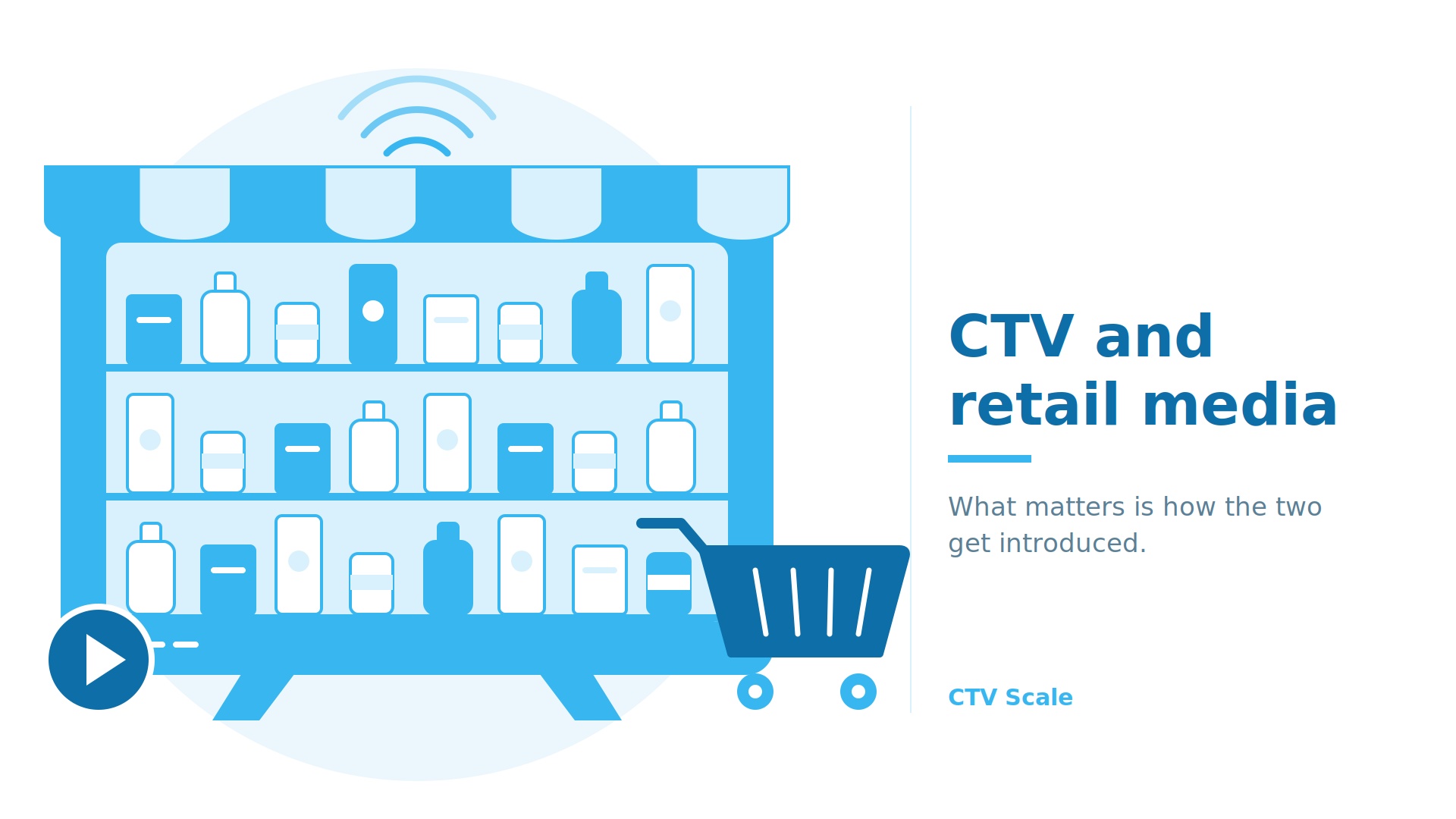
When Viewing Data Meets Buying Data Connected TV knows what people watch. Retailers know what people buy. For most brands, those two kinds of knowledge have sat in different places and never met. Retail media is beginning to change that. It lets brands advertise using a retailer's own shopping data, and when it is joined with CTV, it promises a clearer line from the ad on the screen to the pack in the basket. It is a promising idea, and a harder one to carry out than it first appears. Consider why it matters. A brand runs a strong CTV campaign, the reach numbers look healthy, the creative earns praise, and then someone from finance asks how many packs it actually sold. Connected TV has always been better at earning attention than at proving what that attention was worth. Retailers, from large marketplaces to quick commerce apps to store chains with loyalty programmes, hold detailed records of what people buy. They now sell advertising built on that record. Bring the two together and the idea is simple to state. Choose viewers based on how they shop, show them the ad on the biggest screen in the house, then check whether those households bought afterwards. Each side covers the weakness of the other. CTV is strong on storytelling and reach, and weak at connecting an ad to a sale. Retail data knows exactly what was sold, and has little room for a story. Consider a snack brand that wants to reach households who already buy in its category but rarely buy its own pack. Purchase data can find those households, CTV can put a strong story in front of them, and the follow-up purchase data can show whether the mix worked. That is a genuine step forward, and it explains the growing interest among marketers. It also explains why enthusiasm needs a little discipline. Joining two very different kinds of data is harder than the presentations suggest, and the difficulties sit in places that are easy to overlook. The first complication is identity A television belongs to a household. A shopping account belongs to a person. The two have to be connected, and the connection is rarely clean. The match usually relies on signals such as email addresses, phone numbers or device information, and every link in that chain can slip. A family may share one screen and several phones. Someone may shop from an office laptop and watch from the sofa at home. The outcome is a match rate, and it deserves as much attention as the sales result that follows. If only a modest share of the audience can be matched, the measured effect describes that share and may say little about everyone else. Privacy sits right beside this. Purchase history is personal, and brands should ask how consent was collected and how the data is protected. Many retailers use clean rooms, which are secure environments where two parties compare their data without handing raw records to each other. This protects shoppers, but it also limits how much the brand can inspect for itself. Trust in the process has to make up the difference. The second is who marks the homework A retailer earns money by selling advertising, and it also reports on how well that advertising worked. However honest the people involved, that is a conflict of interest, and it deserves a plain acknowledgement. This is no criticism of retailers, whose data is valuable and whose platforms keep improving. It is a reminder that anyone marking their own paper benefits from an outside check. The measurement itself has a well-known trap. A shopper who was already going to buy a particular brand of tea will appear in the results as someone who bought after seeing an ad. The ad may have changed nothing. Attribution that credits whatever happened just before the purchase flatters every channel that sits close to the till, and CTV can look better than it deserves or, as often, worse. The stronger approach is a holdout test. A comparable group of households does not see the ad, and the two groups are compared. That shows what the campaign added, rather than what was already on its way. The third is what the data cannot see A great deal of retail in India still happens offline, in neighbourhood shops and stores that no app tracks. Online purchase data covers only a slice of shoppers, and often the more urban and digitally comfortable ones. A campaign judged on that slice alone can look stronger or weaker than it really was. Time plays its own tricks. A viewer might see an ad on Monday and buy the product a month later, when the old pack runs out. A short attribution window will miss that entirely. It also pushes CTV into the role of a conversion channel, when its larger strength is building the preference that makes the later purchase easy. What a brand can do None of this is a reason to stay away. It is a reason to ask better questions before the campaign starts. Who holds the data, and how was consent gathered? What is the match rate? Will there be a holdout group, and what result will count as success? How long is the attribution window, and why was that length chosen? Will the brand receive exposure data that it can check independently? Agreeing these points in advance turns measurement from an argument after the fact into a shared plan. It also helps to treat sales results as one view alongside reach, frequency, and brand measures, rather than the only judge. A brand new to this can start small, with one retailer and one product, and treat the first campaign as a test with modest expectations. Viewing data and buying data belong together. The brands that gain the most will be the ones that insist on knowing how the introduction was made.

Why CTV Supply Is Getting Harder to validate

Why CTV Supply Is Getting Harder to validate

4/17/2026|By Sonal Bhardwaj

Connected TV has moved past being an experiment on a media plan. Budgets have moved from TV to streaming. Buyers now expect to bid for premium video inventory just as they bid for any programmatic channel. At glance that seems like a simple extension of digital buying into the living room.. Underneath it is becoming one of the toughest validation challenges in the industry. This is a change from how validation works on the open web. A buyer checking a web impression can look at the domain, the page content, the browser and the referrer. None of these signals are perfect. They give traders a familiar and fairly stable frame of reference. CTV replaces that frame with app bundles, device identifiers and content data all of which are declared by participants in the chain instead of being independently confirmed. Declaring something and proving it are two actions and the gap between them is where most risk in programmatic CTV now lies. Part of what makes this gap is the length of the supply chain. A CTV impression rarely travels in a line from a content owner to a demand side platform. It usually goes through a streaming platform, one or more monetisation partners, an exchange and sometimes a reseller before it reaches a buyer. Each extra hop adds a bit of opacity. Two bid requests can look the same when they reach a buyer even though the paths behind them are completely different. One might be publisher supply. The other might have changed hands three or four times. Both can carry OpenRTB fields, which is why supply path analysis has become as important in CTV as it already is in web and app inventory. The identity problem makes this even worse. Web advertising built its targeting and measurement around cookies, browser signals and mobile advertising identifiers. None of that infrastructure works on a television screen. CTV relies on device identifiers, household level signals from measurement partners and IP based information that has its accuracy limits. This creates two questions that are often treated as one. The first question is whether an identifier is syntactically valid. The second and much more important question is whether that identifier represents an in-market viewer. A large pool of device IDs can look like an audience size on a report but it offers no real evidence that a human was watching. Invalid traffic behaves differently in this environment too. A sudden spike in requests from one streaming app is not automatically suspicious because popular CTV apps can generate huge volume on their own. Automated environments are now sophisticated enough to produce requests that look like CTV traffic with plausible device types and content meta data. The old method of flagging one field no longer works well here. What matters more is looking at combinations of signals including request volume, device distribution, geography and historical performance to spot patterns that do not add up instead of chasing a single red flag. The bigger shift in the industry is a change in what counts as an advantage. For years that advantage came from having inventory. Now it will come from being able to answer a narrower question, with confidence: can you prove that the impression being sold is the impression it claims to be? That question will become more important as CTV budgets keep climbing and the platforms that can answer it clearly will be the ones buyers trust with their spend.

What should advertisers expect from CTV beyond “Awareness”

What should advertisers expect from CTV beyond “Awareness”

4/17/2026|By Sonal Bhardwaj

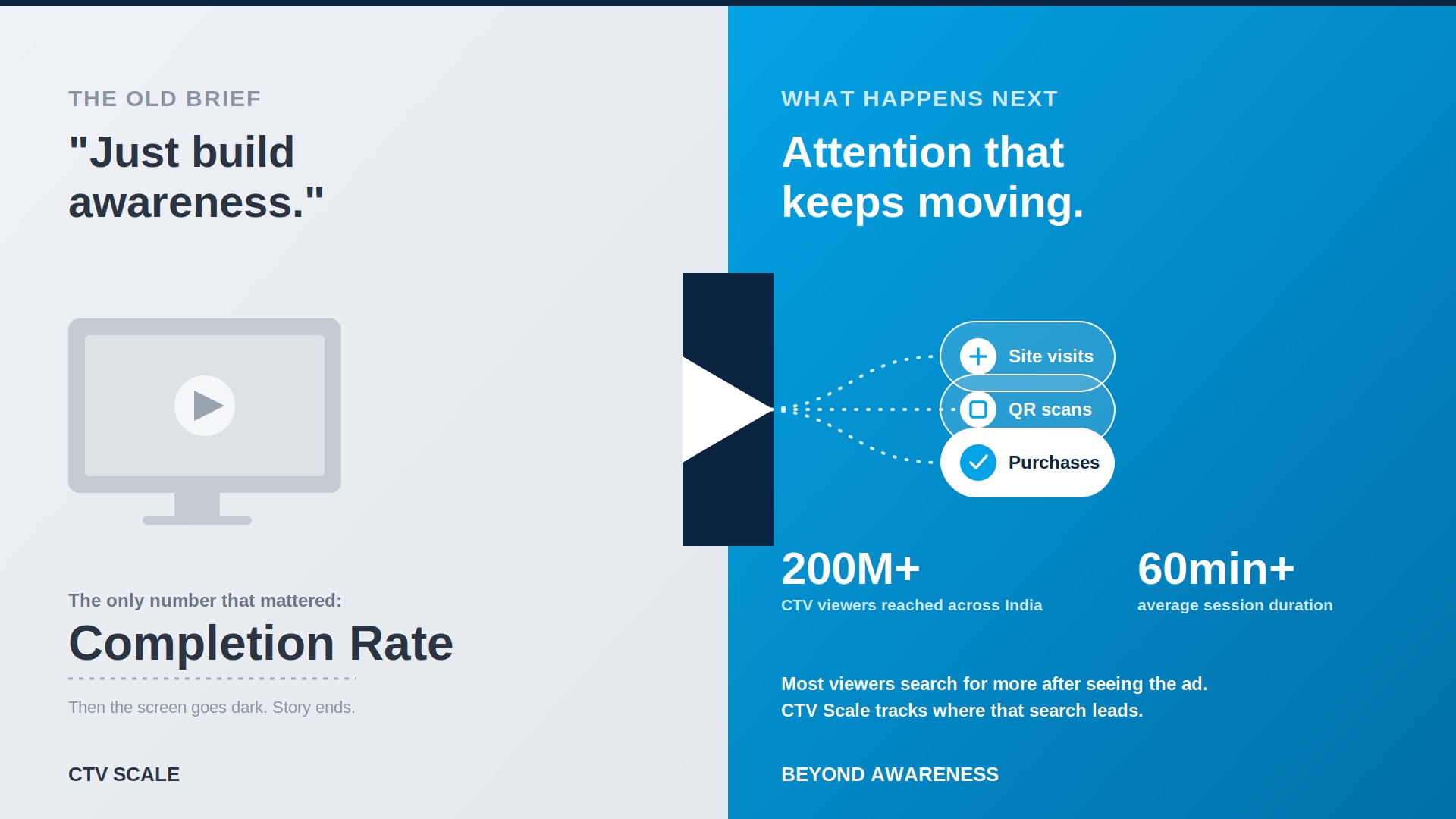
Connected TV has long been seen as a brand channel in media plans. A campaign would play on the screen, completion rates would look good, and that would be the end of the story. Most people assumed that CTV only built awareness while real business results came from search, social, and performance marketing. That assumption is very much just an assumption not the truth. Advertisers who still plan that way are missing a big part of the channel. The change shows in the numbers. CTV now reaches more than 200 million viewers in over 60 million households in India, almost three times the reach a few years ago. What matters more than size is what people do after seeing an ad. Recent research on Indian CTV viewers found that most viewers look for more information after seeing an ad, and the percentage is even higher among premium audiences. This is a channel where attention does not stop when the ad ends. Attention moves from the living room screen to the phone. Then into search, app stores, and storefronts. The reason CTV was hard to credit with business outcomes for long has less to do with the medium and more to do with measurement. A viewer s action after an ad usually does not happen on the device that showed the ad. Nobody clicks a television. The tools that link what people saw on their TV to what they did later have improved a lot, and deterministic attribution is now closing that gap. Advertisers using CTV Scale can track site visits, app installs, QR scans, and registrations back to campaigns. That means the channel can finally be judged on the same terms as any other performance line item while still keeping the scale and premium context that made it attractive. This changes what advertisers should ask for. A media plan that treats CTV as a reach vehicle reporting only video completion rate asks the channel to prove far less than it can. The useful question is what happens after the impression. Formats like pause ads and QR overlays give viewers a way to act while still watching instead of waiting for a later touchpoint. Shoppable formats shorten the gap between seeing a product on screen and thinking about buying it. Interactive and app sync capabilities let a single campaign report on outcomes from brand lift to app opens in the dashboard. None of this takes away the awareness value of the channel. It sits on top of it, turning one flight into a funnel tool instead of a single-stage tool. There is also an advantage that is underused. Average CTV session durations in India often last more than an hour, giving advertisers high‑attention windows in one sitting, not just one exposure to optimize. Brands that design a sequence taking a viewer from an opening story beat to a mid‑campaign moment to a closing conversion prompt tend to see stronger downstream results than brands that repeat the same thirty‑second film in every slot. Treating CTV as a canvas for a journey rather than a slot to fill is where the mid and lower funnel gains really come from. None of this means awareness stops mattering. Premium, large‑screen storytelling still does something that a six‑second mobile clip cannot copy, and category leaders will keep investing for good reason. What has changed is the ceiling. Advertisers, on CTV Scale, no longer need to choose between brand building and measurable outcomes because the same campaign, designed with intent, can deliver both. The advertisers who will get the most out of CTV in the coming year are the ones who stop asking whether the channel can perform and start asking what to measure once it does.