
Blogs

Why CTV Supply Is Getting Harder to validate
Connected TV has moved past being an experiment on a media plan. Budgets have moved from TV to streaming. Buyers now expect to bid for premium video inventory just as they bid for any programmatic channel. At glance that seems like a simple extension of digital buying into the living room.. Underneath it is becoming one of the toughest validation challenges in the industry. This is a change from how validation works on the open web. A buyer checking a web impression can look at the domain, the page content, the browser and the referrer. None of these signals are perfect. They give traders a familiar and fairly stable frame of reference. CTV replaces that frame with app bundles, device identifiers and content data all of which are declared by participants in the chain instead of being independently confirmed. Declaring something and proving it are two actions and the gap between them is where most risk in programmatic CTV now lies. Part of what makes this gap is the length of the supply chain. A CTV impression rarely travels in a line from a content owner to a demand side platform. It usually goes through a streaming platform, one or more monetisation partners, an exchange and sometimes a reseller before it reaches a buyer. Each extra hop adds a bit of opacity. Two bid requests can look the same when they reach a buyer even though the paths behind them are completely different. One might be publisher supply. The other might have changed hands three or four times. Both can carry OpenRTB fields, which is why supply path analysis has become as important in CTV as it already is in web and app inventory. The identity problem makes this even worse. Web advertising built its targeting and measurement around cookies, browser signals and mobile advertising identifiers. None of that infrastructure works on a television screen. CTV relies on device identifiers, household level signals from measurement partners and IP based information that has its accuracy limits. This creates two questions that are often treated as one. The first question is whether an identifier is syntactically valid. The second and much more important question is whether that identifier represents an in-market viewer. A large pool of device IDs can look like an audience size on a report but it offers no real evidence that a human was watching. Invalid traffic behaves differently in this environment too. A sudden spike in requests from one streaming app is not automatically suspicious because popular CTV apps can generate huge volume on their own. Automated environments are now sophisticated enough to produce requests that look like CTV traffic with plausible device types and content meta data. The old method of flagging one field no longer works well here. What matters more is looking at combinations of signals including request volume, device distribution, geography and historical performance to spot patterns that do not add up instead of chasing a single red flag. The bigger shift in the industry is a change in what counts as an advantage. For years that advantage came from having inventory. Now it will come from being able to answer a narrower question, with confidence: can you prove that the impression being sold is the impression it claims to be? That question will become more important as CTV budgets keep climbing and the platforms that can answer it clearly will be the ones buyers trust with their spend.
What should advertisers expect from CTV beyond “Awareness”
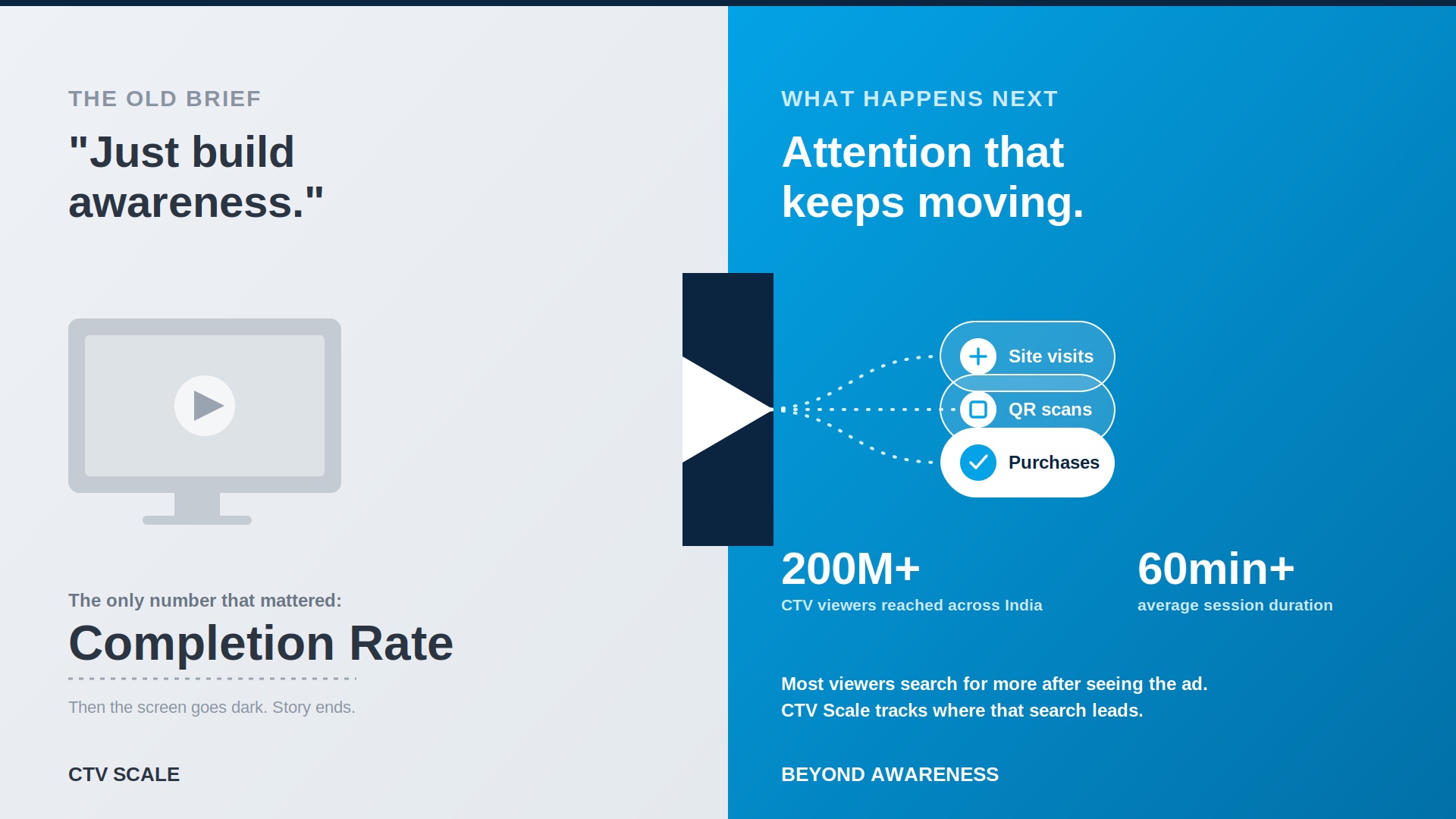
Connected TV has long been seen as a brand channel in media plans. A campaign would play on the screen, completion rates would look good, and that would be the end of the story. Most people assumed that CTV only built awareness while real business results came from search, social, and performance marketing. That assumption is very much just an assumption not the truth. Advertisers who still plan that way are missing a big part of the channel. The change shows in the numbers. CTV now reaches more than 200 million viewers in over 60 million households in India, almost three times the reach a few years ago. What matters more than size is what people do after seeing an ad. Recent research on Indian CTV viewers found that most viewers look for more information after seeing an ad, and the percentage is even higher among premium audiences. This is a channel where attention does not stop when the ad ends. Attention moves from the living room screen to the phone. Then into search, app stores, and storefronts. The reason CTV was hard to credit with business outcomes for long has less to do with the medium and more to do with measurement. A viewer s action after an ad usually does not happen on the device that showed the ad. Nobody clicks a television. The tools that link what people saw on their TV to what they did later have improved a lot, and deterministic attribution is now closing that gap. Advertisers using CTV Scale can track site visits, app installs, QR scans, and registrations back to campaigns. That means the channel can finally be judged on the same terms as any other performance line item while still keeping the scale and premium context that made it attractive. This changes what advertisers should ask for. A media plan that treats CTV as a reach vehicle reporting only video completion rate asks the channel to prove far less than it can. The useful question is what happens after the impression. Formats like pause ads and QR overlays give viewers a way to act while still watching instead of waiting for a later touchpoint. Shoppable formats shorten the gap between seeing a product on screen and thinking about buying it. Interactive and app sync capabilities let a single campaign report on outcomes from brand lift to app opens in the dashboard. None of this takes away the awareness value of the channel. It sits on top of it, turning one flight into a funnel tool instead of a single-stage tool. There is also an advantage that is underused. Average CTV session durations in India often last more than an hour, giving advertisers high‑attention windows in one sitting, not just one exposure to optimize. Brands that design a sequence taking a viewer from an opening story beat to a mid‑campaign moment to a closing conversion prompt tend to see stronger downstream results than brands that repeat the same thirty‑second film in every slot. Treating CTV as a canvas for a journey rather than a slot to fill is where the mid and lower funnel gains really come from. None of this means awareness stops mattering. Premium, large‑screen storytelling still does something that a six‑second mobile clip cannot copy, and category leaders will keep investing for good reason. What has changed is the ceiling. Advertisers, on CTV Scale, no longer need to choose between brand building and measurable outcomes because the same campaign, designed with intent, can deliver both. The advertisers who will get the most out of CTV in the coming year are the ones who stop asking whether the channel can perform and start asking what to measure once it does.
CTV vs Traditional TV Advertising: What Brands Need to Know?
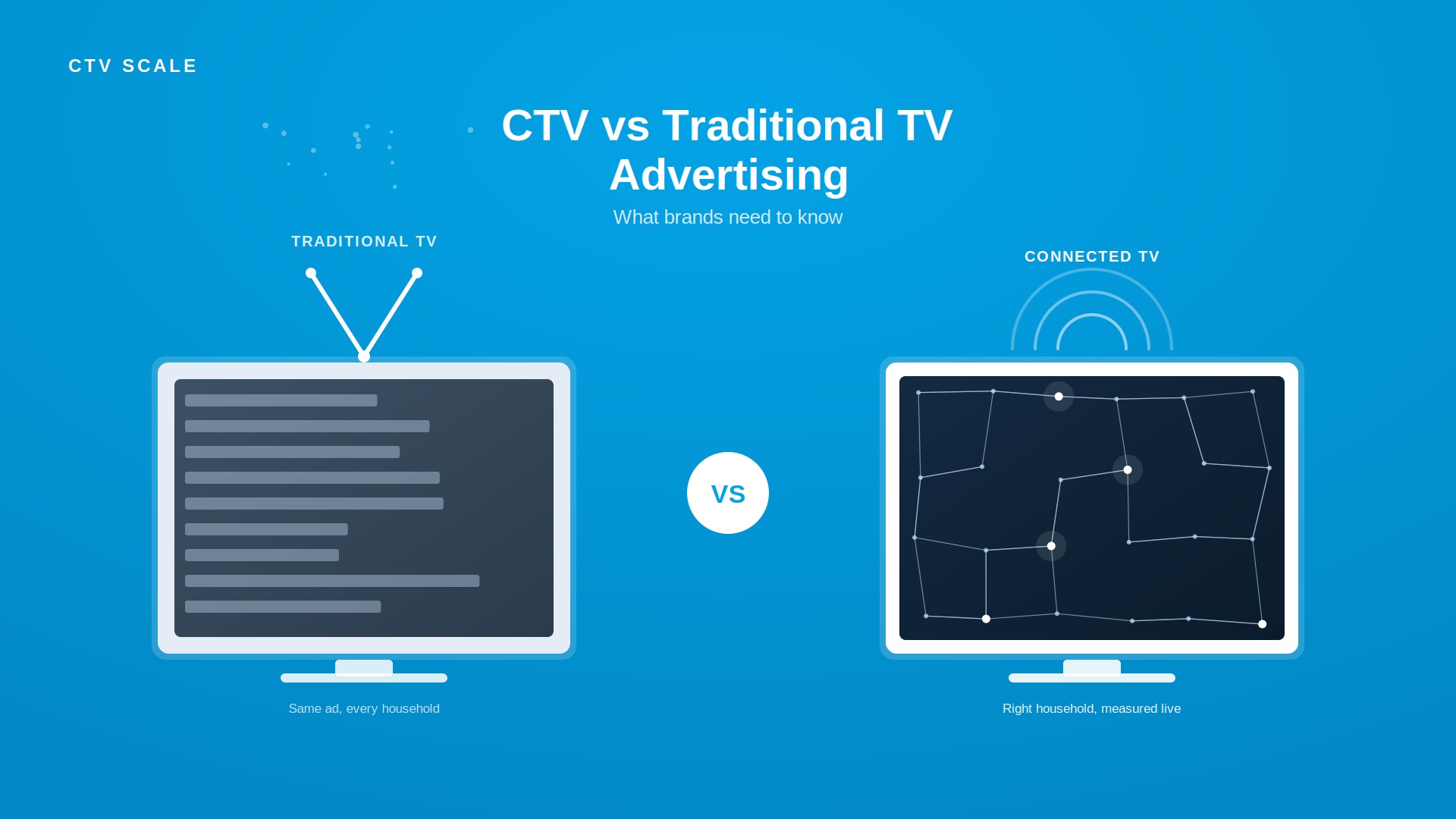
"CTV is not a departure from television advertising. It's television advertising finally living up to its full potential." Television has always been the most powerful advertising medium ever created. The big screen, the lean-back attention, the shared household moment, the storytelling canvas, nothing else comes close. Brands have known this for decades, and that is why TV has commanded the lion's share of premium advertising budgets for as long as most marketers can remember. So when people ask CTV vs. Traditional TV, what should brands know? The most honest answer is this: there is not really a versus. Connected TV is the same television you have always believed in, now running on smarter rails. Same screen. Same room. Same audience attention. Just with tools that were never available before. Think of it the way you had thought of any great upgrade. A printed map and GPS navigation both get you to the same destination. But one of them knows traffic, recalculates when you take a wrong turn, and learns your commute over time. CTV is GPS for television advertising. The Living Room has not changed. The Intelligence Behind It Has. The most important thing to understand about CTV is what has not changed. Viewers are still sitting on their sofas. The television is still the centrepiece of the living room. Families still gather around it. Ads still run in full-screen, with full audio, within professionally produced content environments. The brand-safe, premium, high-attention context that made TV advertising great? That's fully intact. What has changed is everything happening behind the scenes. Traditional linear TV broadcasts the same ad to every household watching a channel at the same time. It was powerful because of reach, and reach alone. CTV retains that reach and then layers on capabilities that were simply impossible in a broadcast world. CTV preserves every strength on which television advertising was built, while adding the precision and accountability that modern brands demand. The shift is not from TV to digital. It is from TV as a broadcast instrument to TV as an intelligent platform. Every CTV impression carries data. Every view tells a story. Every campaign becomes smarter in real time. And one should not take it as a threat to television's legacy because it's the fulfillment of it. What Intelligent Television Actually Looks Like When brands invest in CTV advertising, they are accessing the same premium inventory they always have, just with a new layer of intelligence built in. Audience Targeting, Not Just Channel Buying. Traditional TV buying meant purchasing time on a channel and trusting demographic averages. CTV lets advertisers define their audience precisely by age, interests, viewing behaviour, purchase intent, geography, and more, and reach them wherever they stream, regardless of the channel or platform. Real-Time Performance Measurement With linear TV, campaign performance arrived weeks after the fact through panel-based estimates. CTV delivers live dashboards: impressions served, completion rates, unique reach, cost per completed view, and downstream conversions. Brands know what is working while the campaign is still running. Frequency Management Across Screens One of linear TV's persistent blind spots was over-frequency, the same viewer seeing the same ad twelve times in a week. CTV solves this by tracking exposures at the individual level, capping frequency intelligently so every impression adds value rather than creating fatigue. Incremental Reach for Linear Campaigns Rather than replacing linear TV spend, CTV extends it. By identifying households that are underexposed or not reachable through traditional broadcast, CTV fills the gaps, reaching cord-cutters, streaming-first audiences, and younger demographics who are simply not present on linear TV anymore. Flexible Budget Control Premium television advertising once required large upfront commitments. CTV brings flexible, programmatic buying to the big screen, allowing brands of every size to access premium TV inventory with real-time budget control and performance-based optimisation. Television's Evolution, Not Its Replacement It helps to think of CTV not as a new medium but as the latest chapter in television's long evolution. Television itself has been evolving since its earliest days, from black and white to colour, from analogue to HD, from rabbit ears to cable boxes, from appointment viewing to DVR. Each evolution expanded what television could do for both viewers and brands. CTV is simply the next chapter. The internet has become the distribution layer for television content, and that connectivity has unlocked capabilities that were not technically possible with broadcast infrastructure. But the experience for the viewer and the opportunity for the advertiser remain fundamentally televisual. It's the big screen. It's the living room. It's full-sound, full-screen, premium storytelling. "The medium has not changed. The intelligence powering it has. That's the only distinction that matters for brands." TV's Core Strength How Linear TV Delivered It How CTV Elevates It Brand-safe, premium environment Professionally produced broadcast content Same premium content, plus verified brand safety at the impression level Massive reach National broadcast to millions simultaneously Reaches linear audiences plus cord-cutters and streaming-native households High-attention viewing Lean-back, living room environment Same environment, with data confirming completion rates above 95% Emotional storytelling 30- and 60-second narrative spots Same formats, with interactive and shoppable extensions available Audience targeting Demographic estimates via panels First- and third-party data at the individual household level Campaign measurement GRP-based post-campaign estimates Real-time dashboards with attribution, conversions, and incremental reach For Brands: This Is Still Television. Treat It Like Television. The practical implication for brand teams and media planners is straightforward: CTV deserves the same creative ambition, the same premium positioning, and the same strategic weight as any television campaign. Because it is a television campaign. Brands that have been cautious about shifting budgets toward streaming because it feels unfamiliar should reframe the question entirely. You are not moving your television budget to a digital channel. You are keeping your television budget on television, a smarter television that knows who is watching, measures every impression, and reaches the audiences that broadcast can no longer find. A great 30-second spot that builds brand emotion and tells a compelling story works on CTV exactly as it works on linear TV because it appears on the same screen, in the same living room, watched by the same type of engaged viewer. What CTV adds is the confidence of knowing your story reached the right person, at the right frequency, and the data to prove the impact. A Converged Future, Not a Fragmented One The smartest approach for brands today is not to choose between linear TV and CTV, it is to use them together as a unified television strategy. Linear TV provides the broad, simultaneous reach of a national broadcast moment. CTV extends that reach to the audiences linear can no longer touch, fills frequency gaps, and provides the measurement layer that makes the combined investment provably effective. This convergent approach is exactly what the CTV Scale is built to enable. By bringing together premium CTV inventory, data-driven audience targeting, real-time measurement, and seamless integration with linear TV campaigns, CTV Scale ensures that brands get the full power of television, not a fractured piece of it. Television did not stop being television when it moved to streaming. It got better at being television. The brands that recognise this earliest will be the ones who capture the attention of the audiences everyone else can no longer reach, and do it with the proof to show exactly what that attention was worth.
Common Mistakes Brands Make in CTV Advertising
01 Repurposing TV spots without rethinking the format Dropping a 30-second linear TV commercial onto a CTV platform and calling it done is a trap. CTV viewers are engaged, but they are also one click away from skipping. Ads need to front-load the message, use clearer audio cues (many people watch without subtitles on), and work at smaller screen sizes. A broadcast spot optimized for a 65" living room TV rarely performs the same on a tablet or streaming device menu. 02 Ignoring frequency capping and wrecking the experience CTV's targeting precision is a double-edged sword. Without proper frequency caps, the same household sees the same ad six times in an evening. This does not just waste budget, it actively damages brand perception. Unlike social media, where a user can hide an ad, a CTV viewer is largely a captive audience. Annoyance compounds fast. Set household-level caps, not just device-level ones. 03 Buying inventory without understanding the supply chain CTV has a messy programmatic ecosystem. Brands routinely overpay for the same inventory purchased through multiple intermediaries, or worse, buy spoofed impressions posing as premium streaming. Auditing your supply path, prioritizing direct publisher deals or PMPs, and working with DSPs that offer supply-path optimization is not optional anymore, it's table stakes for efficient CTV buying. 04 Skipping creative testing Many brands run one creative for an entire CTV campaign and wonder why performance plateaus. Unlike traditional TV, CTV supports A/B testing at scale. Testing different hooks in the first five seconds, different calls to action, and even different voiceover tones can yield meaningful performance differences. Treating CTV as a "set it and forget it" channel leaves real gains behind. The brands winning on CTV right now are not necessarily spending more, but they are being more deliberate about every layer of the funnel, from supply chain to creative to measurement. The floor for good CTV advertising is higher than most brands think.
.jpg)
Regional Language Audiences Are India's Fastest-Growing Audience Nobody Is Planning For
Every media plan in India still starts the same way. Hindi general entertainment gets the lion's share of the budget, English content gets the halo positioning for brand safety, and everything else gets filed under regional, a line item that shows up late in the plan and gets treated as a compliance exercise rather than a growth opportunity. That approach made sense when television was linear, and reach was the only currency that mattered. It does not hold up anymore. CTV has quietly turned regional language viewing into the largest and fastest-growing pool of attention in the country, and most brands are still buying it the way they used to buy a Doordarshan slot three decades ago. Look at where the actual viewing is happening. JioHotstar's regional content libraries pull in audiences that rival or exceed Hindi GEC in raw hours watched. Sony LIV and ZEE5 have spent years building out Tamil, Telugu, Bengali, Marathi, and Punjabi catalogues precisely because that is where subscriber growth and watch time are coming from, not from another Hindi drama. FAST channels built around regional cinema and devotional content are among the stickiest, most habitually watched inventory on connected TV today. None of this is a niche. It is the market. What most brands do instead is take a Hindi or English creative, run it through a voiceover pass, and call it localization. The audience notices. A dubbed ad in a regional feed reads as exactly what it is, an afterthought dressed up as inclusion. It does not build the same trust or recall as a piece of content made for that audience, in that language, sitting inside content the audience actually chose to watch. This is where CTV changes the economics of the problem. Linear could not be targeted by language and geography with any real precision, so regional got bundled into a blanket buy and budgeted like a rounding error. CTV can be targeted by genre, language, and gender down to a level where a brand can build a Tamil-first campaign for Tamil Nadu viewers watching Tamil content, with its own creative, its own message, its own budget, rather than a leftover slice of the Hindi plan. The infrastructure to stop treating regional audiences as an afterthought already exists. There is also a measurement argument that brand teams tend to skip. mFilterIt's IVT data has repeatedly shown that fraud and low-quality inventory concentrate where scrutiny is lowest, and regional inventory has historically gotten less attention from verification and brand safety teams than premium Hindi and English slots. If regional is where the growth is, it needs the same rigor applied to it that Hindi GEC gets, not less. None of this is an argument for abandoning Hindi- or English-led plans. It is an argument for building a regional language strategy as its own line, with its own creative brief, its own targeting logic, and its own success metrics, instead of a translation pass tacked onto the main plan. The brands that treat regional CTV audiences as a distinct, high-intent market rather than a footnote are the ones that will own that attention before it becomes obvious to everyone else that they should have. The audience is already there, already watching, already choosing regional content over the alternatives available to it. The only open question left is whether a brand's media plan is built to reach that audience on purpose, or whether it just catches them by accident, the way it always has.

5 Questions to ask your CTV vendor
The fastest way to judge a CTV vendor has nothing to do with the pitch deck. It's how long it takes them to answer a direct question. A vendor who knows their own supply chain answers in seconds. A vendor who needs to get back to you or steers the conversation toward a different slide is usually telling you something too, just not the thing you asked. CTV spend in India has grown faster than the infrastructure needed to hold vendors accountable for it. Budgets have moved from linear TV and digital video into connected TV at a pace most procurement teams have not had time to build proper diligence around. That gap gets filled by trust advertisers taking vendor decks at face value because there is not yet a standard set of questions everyone knows to ask, the way there is for search or programmatic display. That trust gets exploited quietly, and rarely through outright fraud. It is usually through vagueness: numbers that are technically true but framed in a way that hides the part that actually matters. A vendor can report impressive reach, strong completion rates, and healthy attribution numbers, all while sitting on a supply chain that would look very different if you asked to see the underlying data. So instead of another list of red flags, here are the five questions worth asking on every vendor call, why each one matters, and what a good answer should actually sound like. 1. What percentage of my spend is actually working media? When you hand a vendor a budget, that money does not go straight to buying impressions. A portion of it gets absorbed by platform fees, ad serving costs, data licensing, and agency margins before a single ad plays. What is actually left over, the part that buys inventory, is called working media, and it is the only number that reflects what your campaign is genuinely spending on reach. This matters because the gap between gross spend and working media can be substantial, and it's rarely disclosed unless asked for directly. A vendor with nothing to hide will give you this percentage without hesitation, because they have already calculated it internally. Somewhere in the 60-70% range is common depending on the technology stack involved, though it can vary based on how many platforms are stacked between your budget and the final impression. Anything meaningfully lower than that deserves a follow-up question about exactly where the rest of the money is going, and whether each fee attached to it is actually earning its place. 2. Can I see log-level impression data? Dashboards are built to tell a story. They roll thousands or millions of individual impressions into a handful of charts and summary metrics, almost all of which are designed to trend in a reassuring direction. That is not necessarily dishonest, but it is a curated version of the truth. A log file does not have that luxury. It lists every single impression individually, which app it ran in, what time of day it served, what device it reached, and what it cost. There is nowhere for a weak campaign to hide inside a log file the way it can inside a rounded-up summary chart. If a vendor can hand over that raw data without pushback, it is usually a sign they are confident in what it shows. If they can only offer a polished report, it's worth asking directly why the underlying data is not available. Sometimes that is a genuine platform limitation tied to how the ad server was built. Sometimes it is because the summary is doing a lot of quiet work that the raw logs would not support. 3. What percentage of my impressions ran on true CTV/OTT inventory? Streaming inventory has become one of the most elastic terms in Indian digital advertising right now, and that elasticity benefits the seller far more than the buyer. It can mean a premium show running on a Samsung Smart TV in someone's living room, or it can mean a mobile browser playing a video ad that technically qualifies as OTT because the same publisher also happens to run a streaming app. Both of those impressions can get billed at CTV rates, even though the experience, the attention level, and the actual value to the advertiser are nowhere close to the same. This distinction matters more in India specifically because the connected TV base is still growing and the definition of streaming has not been standardized the way it has in more mature markets. Ask specifically what share of your impressions ran on actual connected TV devices, as opposed to mobile, tablet, or desktop screens counted under the same streaming umbrella. And do not settle for a verbal percentage ask to see the device-level breakdown, because a number without the underlying split is just another version of the same vague reassurance. 4. Are you buying direct or through resellers? Every intermediary that sits between an advertiser's budget and the publisher's inventory supply-side platforms, resellers, sub-resellers takes a cut before the impression ever reaches its destination. None of that is inherently a problem. Some intermediaries add real value: better targeting technology, verification tools, access to inventory that would not otherwise be available. Others exist purely as arbitrage, adding a markup without adding anything the advertiser can point to. The issue is not the existence of resellers, it is the lack of visibility into how many of them are involved and what each one is charging for. A vendor who genuinely controls their supply chain should be able to map the path your budget takes, from your account to the final publisher, in a few sentences. A vendor who cannot, or who gets noticeably vague when asked, likely does not have full visibility into their own inventory sourcing either, which means neither do you. 5. What is your attribution methodology: 30, 60, or 90 days? When a vendor reports that a campaign drove a sale, that claim rests entirely on the attribution window they used to measure it, and that window quietly shapes how impressive the results look. A 30-day window is a relatively tight claim: if someone saw an ad and purchased a month later, there is a reasonable case the ad played some role. A 90-day window is a much looser one. A lot happens in a consumer's decision-making over three months that has nothing to do with an ad they scrolled past once. Longer windows produce bigger, more impressive-looking conversion numbers almost by mathematical default, simply because more purchases fall inside a wider net. That is precisely why some vendors default to longer windows without being asked, and why the question needs to be asked directly rather than assumed. Ask not just what the window is, but why that specific window was chosen for your category and purchase cycle. A genuinely considered methodology should have a real answer to that. None of these five questions are hard to answer for a vendor who actually controls their supply chain and stands behind their numbers. That is really the test running underneath all of them, not whether the answer sounds good, but whether it comes easily, with data attached rather than just reassurance. Vagueness on a straightforward, specific question is rarely an accident. It is usually the answer, just not the one that got said out loud.
Why CTV Measurement Needs to Talk About Outcomes, Not Performance
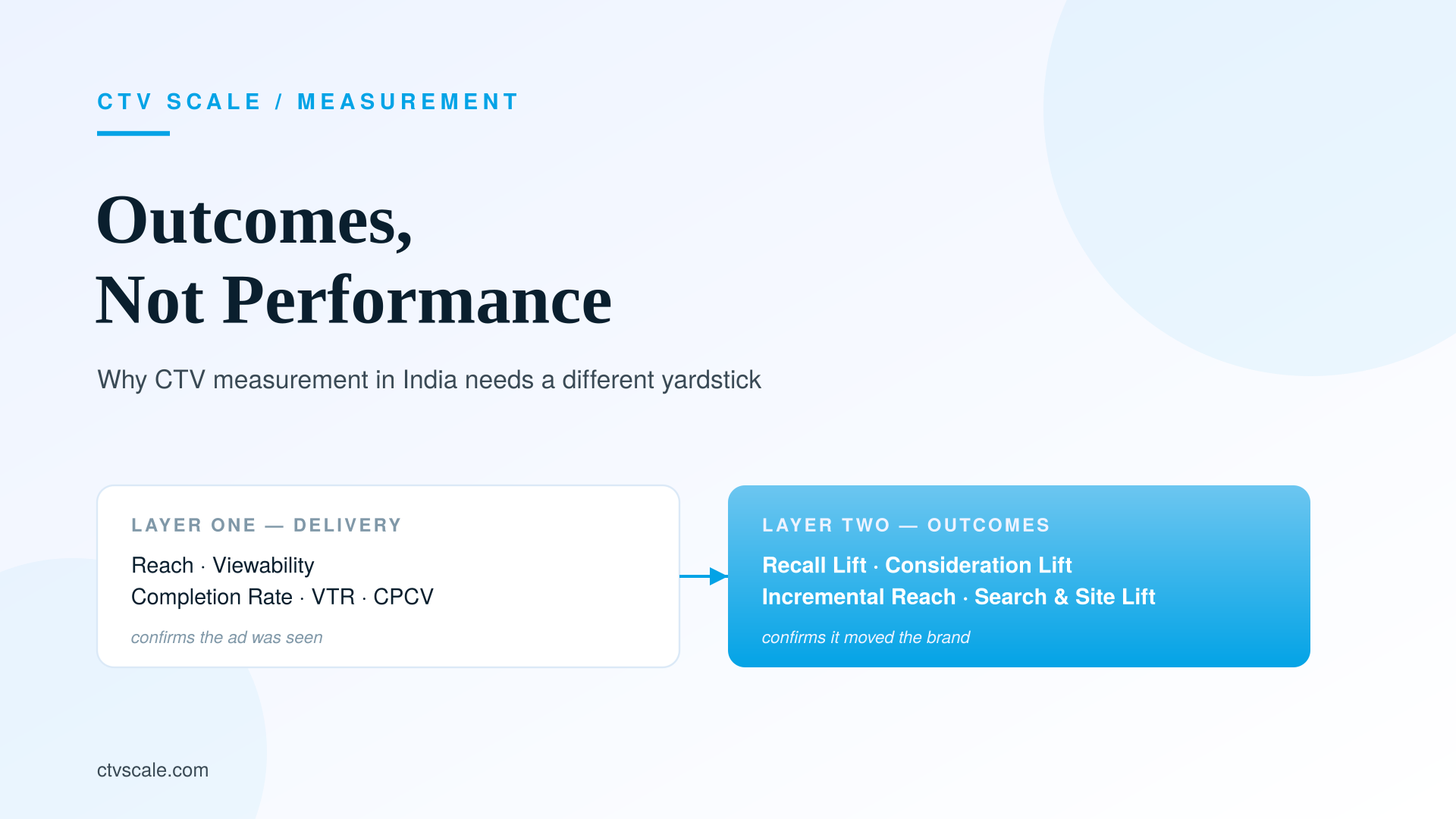
Every conversation about Connected TV in India ends up at the same question. Did it work? Advertisers ask their agencies. Agencies ask their platforms. And the platforms answer with the same list of numbers: reach, impressions, viewability, completion rate, VTR, CPCV. These numbers are useful, and no CTV plan should be built without them. But the word usually attached to this list, performance , is the wrong word, and it is causing real confusion. Performance suggests a straight line from someone seeing an ad to their buying something. That idea comes from search and social media, where a click can be tracked all the way to a purchase in the same sitting. CTV does not work like that. Treating it like it does means judging a brand-building channel by rules it was never meant to follow. A better word is outcomes . Outcomes cover what CTV is actually good at: making people consider a brand, helping them remember it, and moving them a step closer to buying, even if that happens three days later on a phone or a laptop. What the Metrics Actually Tell You Reach and impressions tell you how many households the ad reached. Viewability tells you whether people had a real chance to see it, and on CTV, that chance is usually high, since the ad takes over the full screen on platforms like JioHotstar, SonyLIV, ZEE5, and FAST channels, instead of getting lost in a scrolling feed. Completion rate and VTR tell you whether people watched the whole ad or dropped off halfway. CPCV tells you what that attention cost you. None of these numbers tells you whether the campaign actually changed anything for the brand. They tell you the ad was delivered, not what it achieved. Most CTV measurement conversations in India go wrong right here, when a good completion rate gets treated as the end goal. A 95 percent completion rate only tells you people watched. It does not tell you if it made someone move from not knowing the brand to actually considering it. Where the Real Outcomes Show Up The real outcomes of a CTV campaign usually do not show up in the CTV report at all. They show up somewhere else, in numbers that a brand is already tracking. Things like: how many more people searched for the brand name after the ad ran, how much direct traffic came to the website, or how the brand's search share moved on the e-commerce platforms where people actually buy the product. You can also see it in recall studies, where you compare people who saw the ad against a similar group who did not. And you can see it in incrementality studies, which show what CTV added on top of what other channels were already delivering. This takes more effort than glancing at a dashboard. It means being patient and looking at results over days and weeks instead of expecting an instant answer. But it is a fair way to measure a channel that mostly works on brand building rather than instant sales. If a brand runs CTV to build familiarity before a big festive sale, it should not be judged on clicks, because CTV was never meant to generate clicks. It should be judged on whether more people were considering that brand once the festive season started. India's CTV audience is still figuring out its own viewing habits. People are spread across JioHotstar for live sports and entertainment, SonyLIV and ZEE5 for regional shows, and a growing number of FAST channel viewers who behave differently from people who pay for a subscription. Data from BARC keeps showing that this audience is genuinely new, not the same people just watching on a different screen, which is exactly the kind of value that gets missed when you only measure performance. If a brand only looks at last-click conversions, it ends up underselling the value of every new household CTV brings in, simply because those households were never going to buy on day one, no matter which channel reached them. The fact that CTV in India is spread across so many apps and platforms makes this even more important, not less. The big platforms often limit how much advertisers can actually see about who they reached and how often. In a situation like that, chasing one performance number that nobody can measure consistently across platforms is not a smart use of time. It makes much more sense to track outcomes instead: brand lift, incremental reach, and what happens on search and the brand's website in the days after the ad runs. That gives advertisers one clear way to measure results, no matter which platform, publisher, or FAST channel delivered the ad. A Simple Way to Think About It There are really just two layers to CTV measurement. The first layer is delivery . Did the ad reach the right households, did people actually see it, did they watch it? This is where reach, viewability, and completion rate belong, and platforms owe advertisers honest, clear reporting on these numbers. The second layer is outcomes . Did the campaign actually move the brand forward? This is where recall, consideration, incremental reach, and what happens on search and the website afterward all belong. Both layers matter. But only the second layer really answers the question every advertiser is asking when they say they want to know if it worked. Once a brand gets comfortable with that difference and is willing to wait a bit longer for a real answer, it stops questioning its CTV budget every quarter and starts renewing it instead. CTV was built to be a brand channel first. Measuring it by outcomes, instead of performance, is simply measuring it for what it actually is.
The Pause Ad Problem on CTV
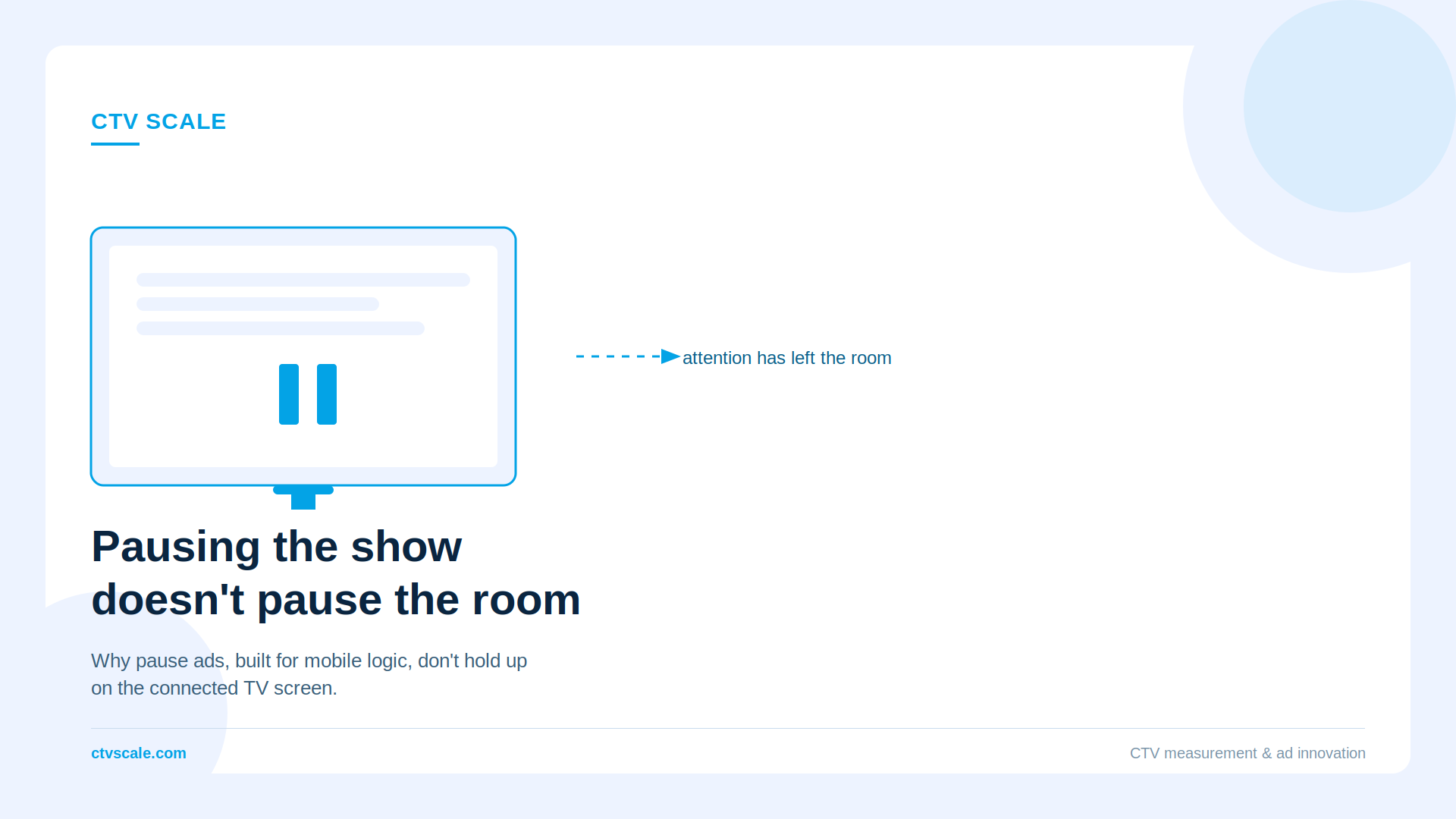
Pause ads have become a default line item in most CTV monetization decks. The logic sounds reasonable on paper. A viewer pauses, the screen goes idle, so why not fill that idle moment with a brand message. It is the kind of inventory that looks good in a rate card and even better in a sales deck, because on the surface it appears to solve a real problem. Dead airtime that would otherwise generate nothing . But the more this format gets scrutinized, the less sense it makes on a connected television, and the industry has largely borrowed the idea wholesale from other screens without asking whether the medium actually supports it. Start with what a pause actually signals, because the assumption baked into this format is that a pause behaves the same way regardless of device, and that assumption does not hold up. On mobile, a pause is often a deliberate, momentary interruption. The viewer is still holding the device, still nearby, still likely to glance back at the screen within seconds because the phone never really leaves their hand in the first place. On CTV, a pause usually signals something else entirely. Someone has stepped away from the room, picked up a phone call, gone to check on the kids, or gotten up to refill a drink. The remote is often nowhere near their hand, sometimes not even in the same room. Attention has not paused along with the content, it has left the room entirely, and often for several minutes rather than several seconds. Serving an ad into that gap is not reaching a viewer at all, it is reaching an empty living room and calling it engagement. Measuring an impression in that moment and reporting it as attention is where the format starts to quietly break down, and where the gap between what is billed and what is actually delivered starts to widen. The second problem is format thinking , and this is where the category has arguably failed the medium even more than it has failed the moment. Pause ads on CTV are, almost without exception, static banners lifted straight from mobile and desktop playbooks, resized and dropped onto a 55-inch screen with little else changed about them. That is a fundamental misreading of the canvas. A large screen viewed from eight feet away, often shared by more than one person in the household, is not a shrunk-down phone, and it never behaves like one. The viewing distance is different, the shared nature of the screen is different, and the expectations a household brings to that screen are different. Treating it like a phone wastes the one advantage CTV inventory is supposed to offer advertisers in the first place, which is scale and visual presence at a size no handheld device can replicate. No brand is actually being served well by a static creative sitting untouched on a paused frame, and no advertiser is getting the kind of impact that justifies CTV's premium pricing when the format itself is borrowed rather than built for the screen it sits on. This is not an execution gap that sharper creative work can fix on its own. It is a category thinking problem, and the ad innovation that CTV as a medium keeps promising simply has not been extended to this format at all. None of this means pause moments are worthless, and the answer is not to abandon the inventory but to rethink what it is actually for. Done differently, pause screens could work well, provided they are treated as contextual, non-intrusive placements that acknowledge the moment for what it is rather than pretending it is a captive viewing window with a guaranteed set of eyes on it. A pause screen could carry a QR-led offer aimed at someone who intends to return to the couch shortly rather than someone assumed to be watching in real time. It could carry a brand cue timed to when playback actually resumes, rather than firing the instant a viewer steps away. The difference, ultimately, comes down to designing for the interruption as it really happens, instead of designing around the illusion that attention is still sitting there, waiting, the whole time the screen is idle.
The Gap Between a Live FAST Channel and a Profitable One
There is a problem playing out across nearly every FAST operator right now, and it is not really a content problem, even though it often gets treated like one. It is actually monetization and delivery, the unglamorous operational layer underneath the channel, failing to keep pace with how fast the format is growing. Channels go live faster than the systems running them can mature, and the gap between the two is where revenue quietly leaks out. The growth numbers explain the pressure. FAST is on track to cross 1,960 channels in 2025, up 21% in a single year. To a viewer, none of that complexity registers open the app, and a channel is already playing, no subscription, no login wall, no friction at all. That ease is the whole pitch, and it is why FAST has scaled the way it has. But on the operator's side, every one of those nearly two thousand channels carries a real operational load that the simplicity on screen completely hides. Programming grids have to stay consistent across time zones without manual patchwork. EPGs have to update automatically and accurately, because a guide that drifts out of sync erodes viewer trust fast. Ad markers have to land precisely because even small placement errors quietly suppress fill rates over time. Rights windows have to be tracked and enforced by region, content has to be refreshed often enough that a channel does not go stale within a few weeks of launch, and every platform it sits on, Roku, Samsung, LG, Amazon, JioHotstar, comes with its own submission specs and technical quirks that have to be met individually. None of this is difficult to manage at a small scale. An operator running three or four channels can hold it together with a spreadsheet and one dedicated person paying close attention. The trouble starts at scale, when that same operator is running twenty, thirty, forty channels across multiple platforms and regions, and the operational load multiplies far faster than the team does. That is when the cracks start showing up in places that matter most, which are fill rates that should be higher than they are, impressions that cannot be cleanly accounted for, and advertisers who hesitate to commit larger budgets because they cannot get reliable proof of delivery. The channel is live, the content is good, the audience is there, and the revenue still underperforms because the operational layer beneath it is not holding. This is also where the conversation about FAST starts to converge with the broader measurement and transparency conversation that has been building across CTV. Operational gaps in grid management, EPG accuracy, and ad marker placement are exactly the kind of blind spots that turn into bigger problems downstream misreported delivery, fraud that is hard to catch because the underlying data was never clean to begin with, and advertisers who cannot get a straight answer about what they actually bought. FAST does not have a viewer problem. It has an infrastructure problem. This is the gap CTV Scale is built to close. We work with operators on exactly the parts of FAST that determine whether a channel actually monetizes the way it should clean ad markers that protect fill rates instead of quietly eroding them, EPG accuracy that platforms and advertisers can trust without question, and grid and rights management that does not drift out of sync as a slate expands across regions and platforms. The goal is not simply keeping channels live, but rather it is making sure every one of them is operating cleanly enough to be sold with confidence and defended the moment an advertiser asks for proof of delivery. Done properly, that kind of operational discipline does not just protect revenue, but it also grows it, channel by channel, without requiring an operator to keep adding headcount at the same rate they are adding channels. FAST does not need fewer channels. It needs operations and monetization infrastructure that can actually keep pace with its growth, and that is precisely the problem CTV Scale exists to solve.
Incremental Reach in CTV
For years, the conversation between CTV and linear has been framed as a reach competition. Who commands more homes, who moves more rating points, and who can fill a media plan with the kind of numbers that keep a planning committee comfortable? And in that framing, linear has always won not because it is the better medium, but because it has the longer history, the deeper agency relationships, and the measurement vocabulary that the industry built its entire buying logic around. But that framing was always the wrong one. The question was never who has more reach. The question was always who has reached the other cannot replicate. Incremental reach is what finally forces that distinction into the open. When a brand runs a campaign on linear and then measures what percentage of its CTV audience had zero exposure to that linear buy, the number is almost always surprising. Not because CTV is reaching more people in aggregate, but because it is consistently reaching a different kind of person, younger, cord-cut or cord-never, consuming content on their own schedule on a screen that a traditional spot buy cannot touch. These are not the same viewers with a different remote in their hands. They are structurally unreachable through linear, and the only way to find them is through CTV. This matters enormously to how we think about budget allocation. The instinct in most media plans, particularly in India, where linear still commands a significant share of video spend, is to treat CTV as an extension of the television buy. A top-up. A frequency driver for audiences already exposed to broadcast. And sometimes that is true and useful. But the more interesting and commercially significant case is when CTV is not extending reach to the same audience but unlocking a population of viewers who simply do not appear on the GRP chart at all. A household that cancelled its DTH subscription and moved entirely to JioHotstar on their smart TV is not a linear audience that has migrated. It is a lost linear audience that CTV can recover, but only if the measurement framework is built to see them. This is where the measurement argument becomes inseparable from the advertiser trust argument. Brands that have spent decades buying linear television have a deeply ingrained belief that television reach is GRP reach. If something is not showing up in BARC data, it is not reaching anyone worth reaching. CTV disrupts that belief, but it cannot simply assert disruption. It has to prove it with a metric that linear cannot manufacture. Incremental reach is that metric. The sophistication of this argument is also its commercial power. When incremental reach data is clean and credible, when it comes from independent measurement rather than from the platform selling the inventory, it does something valuable for the entire category. It moves CTV out of the conversation about efficiency and into the conversation about necessity. Efficiency arguments say CTV is a cheaper way to reach a television audience. Necessity arguments say there is an audience that does not exist anywhere else, and CTV is the only way to find them. One of those arguments competes with linear on price. The other makes linear irrelevant for a specific audience segment. India is at an early but critical point in this shift. Smart TV penetration is growing fast, the connected home is becoming the norm in urban and increasingly in tier-2 markets, and streaming platforms are investing heavily in premium content that commands genuine attention. The conditions for incremental reach to become a defining metric are already in place. That willingness is coming. And when it arrives in full, the brands that had already built their CTV strategy around incremental reach data will find themselves with a very different kind of advantage, not just better media efficiency, but a defensible claim to audiences their competitors cannot reach at all.
.jpeg)
Scaling CTV Without Sacrificing Targeting Precision
The rapid migration of viewers from linear broadcasting to Connected TV (CTV) has presented advertisers with a Strategic yet frustrating landscape. While the promise of digital precision on the big screen is the primary draw, the reality often falls short because the industry is still trying to apply mobile-first tracking to a shared household device. As we navigate 2026, achieving true scale in CTV requires a departure from traditional third-party data reliance, which is increasingly fragmented and inaccurate, and a shift toward a strategy that respects the unique nature of the television medium. To scale effectively without diluting your targeting, you must move beyond the missing demographic data of the CTV bid stream and embrace a more sophisticated, content-first approach. 1. Bridging the First-Party Data Gap The foundation of any successful CTV campaign is the shift away from volatile third-party data. In the CTV ecosystem, third-party cookies are nonexistent, and household-level demographic data is often incomplete or outdated. To achieve precision, advertisers must leverage their own first-party data as the North Star. By integrating your CRM data and website visitor insights into the CTV bid stream, you move from guessing who is behind the glass to targeting known entities. This first-party intelligence allows you to build robust lookalike models that find new high-value households based on actual purchase history rather than unreliable third-party proxies, ensuring that every dollar spent on a big screen impression is grounded in verified consumer behavior. 2. Prioritizing Contextual Over Demographic Targeting A significant hurdle in CTV is the shared screen problem: a single device is often used by multiple family members. As a result, individual demographic targeting (such as age or gender) is becoming harder to rely on. Instead of chasing a specific person who might not even be the one holding the remote, advertisers are returning to the strengths of traditional television, which is content-based advertising. By targeting specific genres, shows, or apps that align with your product, you ensure your message reaches a viewer in the right mindset. On CTV, the content being consumed is the most accurate signal of the audience's intent. If they are watching high-end travel documentaries, the context provides more targeting precision than a missing or inaccurate demographic tag ever could. 3. Achieving TV Scale with Digital Accountability To scale CTV, you must treat the platform like a television for reach but like a digital asset for measurement. This means moving toward household-level targeting using IP addresses and device graphs rather than individual user tracking. This approach allows you to achieve massive reach across premium Lean Back environments while maintaining the Lean Forward analytics of digital marketing. By mapping CTV impressions to downstream actions such as a website visit on a laptop or a purchase on a smartphone within the same household, you can prove ROI and optimize your spend in real-time. This dual-pronged strategy ensures you do not need to choose between the broad impact of a TV ad and the surgical precision of a digital campaign. 4. Navigating the Nuances of the CTV Bid Stream Understanding the technical limitations of the CTV bid stream is essential for maintaining precision at scale. Unlike the open web, the CTV environment is a fragmented collection of hardware manufacturers, app developers, and streaming services, each with its own data standards. Because traditional identifiers are often stripped out or missing during the ad request, scaling often leads to wasted spend on low-quality inventory if not managed correctly. By focusing on direct-to-publisher deals or curated private marketplaces (PMPs), advertisers can ensure they are buying high-quality, human-verified impressions. This level of control allows you to scale your reach across the most popular streaming platforms without losing the granular control over where and when your ads appear. In conclusion, the path to CTV success is not found by trying to force-fit mobile tracking onto the living room screen, but by evolving your strategy to match the medium s unique strengths. By anchoring your campaigns in first-party data, prioritizing contextual relevance, and measuring at the household level, you can achieve the massive scale that television offers without sacrificing the precision that modern digital marketing demands. The future of CTV belongs to those who stop chasing users and start engaging audiences within the right context.
.jpg)
CTV Scale: Reaching Millions While Maintaining Brand Safety
The way we watch TV has changed forever. Gone are the days when families huddled around a single set tuned to a broadcast network. Today, millions of viewers stream their favourite shows on smart TVs, gaming consoles, and streaming sticks, but on their own schedule, on their own terms. This shift has created an enormous opportunity for advertisers. But with opportunity comes a new challenge: how do you reach those millions of viewers without your brand ending up in the wrong place? What is CTV Scale? CTV Scale is a Connected TV-first advertising platform that helps brands plan, execute, and measure campaigns across the world's streaming platforms, all from a single, unified platform. Think of it as the bridge between advertisers who want to reach audiences and the inventory owners who own premium streaming inventory. Rather than forcing brands to juggle multiple vendors, platforms, and data sources, CTV Scale brings everything together: inventory, targeting, creative, measurement, and brand safety under one roof. What Makes CTV Scale Different? 1. Premium CTV Inventory at Scale CTV Scale connects advertisers directly to leading streaming publishers. This approach creates one of the largest optimised supply paths in connected TV, giving brands streamlined access to premium inventory at scale while maintaining efficiency and transparency across the buying process. 2. Precision Targeting That Actually Works on TV Television has long been valued for its ability to deliver mass reach, and with the rise of streaming, that reach is becoming even more precise. CTV Scale builds on the strengths of TV by introducing targeting designed for the streaming era. TV channel-based audiences allow brands to reach viewers based on the channels and content genres they actively watch, while genre-based prime inventory ensures ads appear in the most relevant content environments. This approach is further strengthened through CTV Scale s partnership with Nielsen, bringing trusted audience insights and measurement capabilities that help brands plan, target, and evaluate campaigns with greater confidence across connected TV environments. 3. Brand Safety and Ad Fraud Prevention This is where CTV Scale really earns its stripes. Brand safety is not an afterthought bolted onto the platform; rather, it is embedded at the core. The platform ensures optimal ad placement and actively works to prevent ad fraud, giving advertisers confidence that their budget is being spent on real, premium inventory in appropriate content environments. To further strengthen this commitment, CTV Scale has partnered with mFilterIt, a leading ad fraud prevention and brand safety validation platform, to bring an additional layer of protection to every campaign. Through this partnership, advertisers benefit from real-time invalid detection, automated blocking of fraudulent impressions, and verification that every ad is served in a brand-safe environment, to the right audience, at the right frequency. Together, CTV Scale and mFilterIt ensure that what gets measured is real, what gets seen is relevant, and what gets spent is never wasted. 4. A True TV Environment CTV Scale is strict about what counts as "Connected TV." The platform focuses on streaming TV-first placements, meaning ads appear on actual television screens in genuine streaming environments, not on mobile apps or websites masquerading as CTV inventory. This distinction is more important than it sounds: true CTV placements deliver higher engagement, better completion rates, and a more premium brand experience. 5. Real-Time Measurement and Attribution Brands can monitor campaign performance live through a real-time dashboard, tracking metrics that matter: impressions, unique reach, completion rate, view-through rate, cost per completed view, and more. This level of transparency is a step-change from traditional TV buying, where measurement was always delayed and often estimated. Who Is CTV Scale For? CTV Scale serves two sides of the advertising ecosystem: Buyers (Advertisers and Agencies): Brands looking to scale their CTV presence, reach incremental audiences beyond their linear TV buys, and do so efficiently and safely. Sellers (Publishers and Inventory Owners): Streaming platforms and media owners who want to unlock the full value of their ad inventory through transparent, high-quality demand. The platform is already active across markets, including India, the UAE, the USA, Indonesia, South Africa, and several Southeast Asian markets, making it a genuinely global proposition. The Bigger Picture: Convergent TV One of CTV Scale's most forward-looking features is its Convergent TV approach. Rather than treating streaming TV separately from traditional TV, the platform helps advertisers reach audiences who have drifted away from linear TV by finding them across FAST (Free Ad-Supported Streaming TV), OTT (Over-The-Top) platforms, and native streaming apps. This means brands can run a coordinated strategy that covers both traditional and streaming TV, ensuring they do not leave a growing segment of their audience behind. The television industry is in the middle of a generational transformation. Audiences have moved to streaming, and advertisers need to follow, but they need to do so smartly, safely, and at scale. CTV Scale offers a compelling answer: a purpose-built platform that gives brands the reach of mass-market television with the precision, transparency, and safety of modern digital advertising. For any brand serious about staying relevant with today's TV audience, it's a platform worth knowing. Learn more at ctvscale.com

CTV vs OTT: What's the Difference?
The advertising industry uses terms like CTV and OTT frequently, often interchangeably. This creates confusion for marketers trying to understand where their ads will actually appear and who they will reach. Let us break down this for you, what each term means, and why the distinction matters for your advertising strategy. What is CTV? CTV (Connected TV) refers specifically to televisions connected to the internet. This includes smart TVs with built-in internet connectivity from brands like Samsung, LG, and Sony, traditional TVs with streaming devices such as Roku, Amazon Fire TV Stick, Apple TV, and Chromecast, as well as gaming consoles with streaming capabilities like PlayStation and Xbox. CTV is about the device, not the content or delivery method. The same Netflix show qualifies as CTV advertising when viewed on a television screen, but not when watched on a mobile device. The defining characteristic is the physical television display, regardless of how it connects to the internet. What is OTT? OTT (Over-The-Top) describes content delivered directly to viewers via the internet, bypassing traditional cable or satellite providers. The term "over-the-top" refers to content going "over" conventional distribution methods. Common OTT platforms include Netflix, Hulu, Amazon Prime Video, Disney+, HBO Max, YouTube, Peacock, and Paramount+. These services deliver content directly to consumers without requiring a cable subscription or satellite dish. OTT focuses on the delivery method rather than the device. Whether viewers watch on a phone, laptop, tablet, or television does not change the fact that it is OTT content. The key factor is that content reaches consumers directly via the internet, not through traditional TV providers or cable boxes. The Key Distinctions CTV refers to the device, internet-connected television screens. OTT refers to the delivery model, content provided directly to consumers, bypassing traditional TV distribution. A practical example clarifies this distinction: When you watch Netflix on your Roku device, you are accessing content from an OTT platform (delivery model) on a CTV device (television). If you watch that same Netflix content on your smartphone during your commute, it is still OTT, but it's no longer CTV. Why This Matters for Advertising The distinction between OTT and CTV advertising has significant implications for campaign strategy and performance. OTT advertising reaches audiences across all devices, such as televisions, smartphones, tablets, and computers. This provides a broader reach but less control over the viewing context. CTV advertising specifically targets viewers on television screens, offering a more focused approach with the premium experience of the living room environment. This distinction matters because viewing context differs significantly between devices. Television viewing often occurs in living rooms with multiple people, while mobile viewing is typically individual and on-the-go. Creative requirements also change based on screen size. A 15-second vertical video ad optimized for mobile will not perform well on a 55-inch television screen. Audience behavior varies considerably as well. Shared viewing versus individual consumption affects message retention and brand recall. Engagement metrics differ by device type, with completion rates, attention levels, and conversion patterns varying substantially across screens. Additionally, ad formats and opportunities change depending on the platform. CTV allows for interactive features using TV remotes, while mobile OTT enables touch-based interactions. When planning a campaign, clarifying whether you are targeting OTT (all devices) or CTV (TV screens only) ensures your strategy, creative development, and measurement framework align with your goals. This clarity directly impacts how you allocate resources and measure success. Industry Usage The advertising industry does not always use these terms precisely. Some practitioners say "OTT" when they specifically mean CTV inventory. Others use "CTV" as a catch-all for streaming advertising across all platforms. This inconsistency stems from the rapid evolution of the streaming landscape and the fact that many platforms serve content across multiple device types simultaneously. Understanding the technical definitions helps you communicate clearly with partners and vendors, even when industry usage varies. It prevents miscommunication that could derail campaigns or lead to disappointing results. Practical Application When discussing campaigns with your team or agency partners, specificity matters. For TV screen advertising, you might say you're running a CTV campaign targeting living room audiences. For cross-device strategies, you are executing an OTT strategy across all screens to maximize reach. When seeking clarification, ask whether their reference to OTT includes mobile and desktop inventory or focuses exclusively on CTV placements. Clear communication prevents misaligned expectations and ensures campaign execution matches your objectives. It also helps in budget allocation, as CTV inventory typically commands premium CPMs due to the lean-back, high-attention viewing environment that television provides. Understanding these distinctions allows you to navigate advertising conversations with precision and ensures your campaigns target the right audiences on the right devices. As streaming continues to fragment across platforms and devices, this clarity becomes increasingly valuable for optimizing performance and demonstrating ROI. Whether you are allocating budget, briefing creative teams, or evaluating campaign results, knowing exactly what you are buying and what outcomes to expect makes the difference between effective streaming advertising and wasted spend. The streaming landscape will only grow more complex, making foundational knowledge of these terms essential for any modern marketer.

What is CTV Scale?
CTV Scale is the Connected TV First Advertising Platform built to drive sustainable growth by developing and implementing robust CTV AdTech solutions that maximize revenue and monetization opportunities. CTV Scale helps advertisers to secure a huge reach like linear TV and leverage the precision of digital advertising in the connected TV ecosystem. On the other hand, the platform allows inventory owners to maximize their revenue not only through video ad inventory but also by focusing on other ad units such as Native, Banner, and Video banner. What is CTV(Connected TV) Connected TV (CTV) is a television that connects to the internet, either through built-in capabilities (smart TVs) or external devices like Roku, Amazon Fire TV Stick, Apple TV, or gaming consoles. This connectivity allows viewers to stream content from online platforms on their television screens, bypassing traditional cable or satellite services. CTV has transformed how audiences consume video content, enabling on-demand viewing, personalized recommendations, and interactive features while also creating new opportunities for targeted advertising that combines the reach of traditional TV with the precision of digital marketing. What is CTV Advertising CTV advertising is the delivery of video ads through internet-connected television devices and streaming platforms, combining the storytelling power of traditional TV along with the precision of digital marketing. Unlike linear TV that broadcasts the same ads to all viewers, CTV advertising uses programmatic technology to target specific audiences based on demographics, interests, viewing behavior, and purchase intent, delivering personalized ads across streaming services like Hulu, Peacock, and FAST channels. For advertisers, CTV offers measurable performance tracking, including completion rates, post-view actions, and conversion attribution, flexible budget control with real-time campaign optimization, and access to audiences who have abandoned traditional television. This convergence of premium brand-building context and data-driven accountability makes CTV advertising valuable for both awareness campaigns and direct response objectives, while remaining accessible to businesses of all sizes through programmatic buying platforms. The CTV Device Ecosystem CTV scale is powered by a diverse range of devices that bring streaming content to the big screen: Smart TVs Modern televisions with built-in internet connectivity and streaming apps. Brands like Samsung, LG, Vizio, and Sony dominate this space, often featuring their own operating systems and app marketplaces. Streaming Devices Dedicated devices that connect to traditional TVs include Roku, Amazon Fire TV Stick, Apple TV, and Google Chromecast. These plug-and-play solutions have democratized access to streaming content. Gaming Consoles PlayStation, Xbox, and Nintendo Switch double as CTV platforms, particularly popular among younger demographics who use these devices for both gaming and streaming entertainment. Set-Top Boxes Cable and satellite providers like Comcast's Xfinity and AT T's DirecTV offer hybrid boxes that combine traditional TV with streaming capabilities. Why is CTV growing? Connected TV is growing rapidly because it matches modern viewing behavior, where audiences prefer on-demand, personalized, and platform-driven content over fixed broadcast schedules. The widespread availability of high-speed internet, affordable streaming access, and a growing library of premium digital content have accelerated the shift from linear television to streaming environments. At the same time, advertisers are increasing investment in CTV because it offers precise audience targeting, real-time measurement, flexible budget control, and clear performance attribution, making it a more efficient, accountable, and scalable alternative to traditional television advertising. From Passive Viewing to Intelligent Engagement Traditional television treated viewers as anonymous households. CTV changes that paradigm completely. Every interaction within the CTV environment generates data. What people watch, how long they watch, when they stop, what devices they use, and which ads they engage with all of this creates a powerful feedback loop. This data fuels advanced targeting, personalization, and performance measurement. CTV scale is not just about reach, it is about intelligent reach. Advertisers can identify and connect with specific audience segments defined by demographics, interests, viewing behavior, shopping intent, and lifestyle attributes. The result is advertising that feels less like an interruption and more like relevance. For Publishers, CTV scale unlocks unprecedented monetization potential. Streaming platforms support diverse revenue models, including advertising-supported tiers, subscription-based services, transactional purchases, and hybrid approaches. Scale ensures that each model remains economically viable, even for niche or specialized content categories. CTV advertising commands premium CPMs, often exceeding those of traditional digital formats. High completion rates, engaged audiences, and premium viewing contexts justify these higher prices, directly boosting publisher revenues. For many platforms, CTV now represents the most profitable segment of their digital business. Global distribution further amplifies revenue opportunities. Content can travel seamlessly across borders, while advertising remains localized through geo-targeting. A single piece of content can generate revenue across multiple markets, each with tailored monetization strategies. Why CTV Scale Is Transformational for Advertisers For advertisers, CTV scale represents the convergence of brand storytelling and performance marketing. Television has always excelled at storytelling. The large screen, immersive audio, and relaxed viewing environment create a unique psychological impact. CTV preserves these strengths while adding digital precision. Performance measurement further strengthens CTV s appeal. Every impression can be tracked, every view analyzed, and every conversion attributed. Marketers gain visibility into completion rates, frequency of exposure, incremental reach, and downstream actions such as website visits or in-store purchases. This level of accountability transforms television from a branding channel into a full-funnel performance engine. CTV scale also democratizes access to television advertising. In the past, high production costs and minimum spend thresholds locked out small and medium businesses. Programmatic CTV buying eliminates these barriers, allowing advertisers to enter television with flexible budgets and precise control. Whether a local retailer or a multinational brand, advertisers can purchase exactly the inventory they need. Perhaps most importantly, CTV environments offer brand safety and premium context. Ads appear within professionally produced content, free from the brand risks associated with user-generated platforms. This trust, combined with the lean-back viewing experience, elevates brand perception and recall. The Virtuous Cycle of Scale What makes CTV scale self-reinforcing is how it creates competitive advantages that lead to more scale. Advertisers who achieve success with CTV invest more, which increases publisher revenue, which enables better content and technology, which attracts more viewers, which attracts more advertisers. Publishers operating at scale can afford the premium sports rights, the exclusive shows, and the original programming that drives audience growth. They can invest in the recommendation algorithms and user interfaces that keep viewers engaged and coming back. For advertisers, scale enables cross-platform strategies that ensure consistent messaging across the fragmented streaming landscape. It provides access to cord-cutters, those affluent, younger viewers who never subscribed to traditional television and represent the future of media consumption. The scale of data enables real-time optimization that was impossible in traditional television, where campaigns were locked in weeks before they aired. The Operational Efficiency of Scale CTV scale also transforms operational efficiency. Programmatic infrastructure allows publishers to automate ad sales, accessing thousands of advertisers simultaneously. This ensures higher fill rates, optimized pricing, and reduced dependency on traditional sales teams. Inventory that once went unsold now becomes monetizable at scale, maximizing revenue yield. At the same time, scale enables deeper technology investments. Larger platforms can build sophisticated recommendation engines, improve streaming quality, and enhance user experience, driving higher retention and engagement. These improvements create a positive feedback loop, where better experiences attract more viewers, which in turn attract more advertisers. The CTV scale story is still being written, but its trajectory is clear. As more households cut the cord, as more content moves to streaming platforms, and as the technology becomes ever more sophisticated, the scale will only grow. For advertisers and publishers willing to embrace this new landscape, the opportunities are extraordinary and inevitable.