What's New ?
● CTV is not a medium, but an experience● Data, AI, and Innovation: Shaping the Future of Programmatic● The Growth Story Continues● CTV is not a medium, but an experience● Data, AI, and Innovation: Shaping the Future of Programmatic● The Growth Story Continues

The Gap Between a Live FAST Channel and a Profitable One
Sonal Bhardwaj
5 min read

The Gap Between a Live FAST Channel and a Profitable One

There is a problem playing out across nearly every FAST operator right now, and it is not really a content problem, even though it often gets treated like one. It is actually monetization and delivery, the unglamorous operational layer underneath the channel, failing to keep pace with how fast the format is growing. Channels go live faster than the systems running them can mature, and the gap between the two is where revenue quietly leaks out.

The growth numbers explain the pressure. FAST is on track to cross 1,960 channels in 2025, up 21% in a single year. To a viewer, none of that complexity registers open the app, and a channel is already playing, no subscription, no login wall, no friction at all. That ease is the whole pitch, and it is why FAST has scaled the way it has.


But on the operator's side, every one of those nearly two thousand channels carries a real operational load that the simplicity on screen completely hides. Programming grids have to stay consistent across time zones without manual patchwork. EPGs have to update automatically and accurately, because a guide that drifts out of sync erodes viewer trust fast. Ad markers have to land precisely because even small placement errors quietly suppress fill rates over time. Rights windows have to be tracked and enforced by region, content has to be refreshed often enough that a channel does not go stale within a few weeks of launch, and every platform it sits on, Roku, Samsung, LG, Amazon, JioHotstar, comes with its own submission specs and technical quirks that have to be met individually.


None of this is difficult to manage at a small scale. An operator running three or four channels can hold it together with a spreadsheet and one dedicated person paying close attention. The trouble starts at scale, when that same operator is running twenty, thirty, forty channels across multiple platforms and regions, and the operational load multiplies far faster than the team does.

That is when the cracks start showing up in places that matter most, which are fill rates that should be higher than they are, impressions that cannot be cleanly accounted for, and advertisers who hesitate to commit larger budgets because they cannot get reliable proof of delivery. The channel is live, the content is good, the audience is there, and the revenue still underperforms because the operational layer beneath it is not holding.


This is also where the conversation about FAST starts to converge with the broader measurement and transparency conversation that has been building across CTV. Operational gaps in grid management, EPG accuracy, and ad marker placement are exactly the kind of blind spots that turn into bigger problems downstream misreported delivery, fraud that is hard to catch because the underlying data was never clean to begin with, and advertisers who cannot get a straight answer about what they actually bought. FAST does not have a viewer problem. It has an infrastructure problem.


This is the gap CTV Scale is built to close. We work with operators on exactly the parts of FAST that determine whether a channel actually monetizes the way it should clean ad markers that protect fill rates instead of quietly eroding them, EPG accuracy that platforms and advertisers can trust without question, and grid and rights management that does not drift out of sync as a slate expands across regions and platforms.


The goal is not simply keeping channels live, but rather it is making sure every one of them is operating cleanly enough to be sold with confidence and defended the moment an advertiser asks for proof of delivery. Done properly, that kind of operational discipline does not just protect revenue, but it also grows it, channel by channel, without requiring an operator to keep adding headcount at the same rate they are adding channels.


FAST does not need fewer channels. It needs operations and monetization infrastructure that can actually keep pace with its growth, and that is precisely the problem CTV Scale exists to solve.

 

More Stories

Why CTV Supply Is Getting Harder to validate

Why CTV Supply Is Getting Harder to validate

6/30/2026|By Sonal Bhardwaj

Connected TV has moved past being an experiment on a media plan. Budgets have moved from TV to streaming. Buyers now expect to bid for premium video inventory just as they bid for any programmatic channel. At glance that seems like a simple extension of digital buying into the living room.. Underneath it is becoming one of the toughest validation challenges in the industry. This is a change from how validation works on the open web. A buyer checking a web impression can look at the domain, the page content, the browser and the referrer. None of these signals are perfect. They give traders a familiar and fairly stable frame of reference. CTV replaces that frame with app bundles, device identifiers and content data all of which are declared by participants in the chain instead of being independently confirmed. Declaring something and proving it are two actions and the gap between them is where most risk in programmatic CTV now lies. Part of what makes this gap is the length of the supply chain. A CTV impression rarely travels in a line from a content owner to a demand side platform. It usually goes through a streaming platform, one or more monetisation partners, an exchange and sometimes a reseller before it reaches a buyer. Each extra hop adds a bit of opacity. Two bid requests can look the same when they reach a buyer even though the paths behind them are completely different. One might be publisher supply. The other might have changed hands three or four times. Both can carry OpenRTB fields, which is why supply path analysis has become as important in CTV as it already is in web and app inventory. The identity problem makes this even worse. Web advertising built its targeting and measurement around cookies, browser signals and mobile advertising identifiers. None of that infrastructure works on a television screen. CTV relies on device identifiers, household level signals from measurement partners and IP based information that has its accuracy limits. This creates two questions that are often treated as one. The first question is whether an identifier is syntactically valid. The second and much more important question is whether that identifier represents an in-market viewer. A large pool of device IDs can look like an audience size on a report but it offers no real evidence that a human was watching. Invalid traffic behaves differently in this environment too. A sudden spike in requests from one streaming app is not automatically suspicious because popular CTV apps can generate huge volume on their own. Automated environments are now sophisticated enough to produce requests that look like CTV traffic with plausible device types and content meta data. The old method of flagging one field no longer works well here. What matters more is looking at combinations of signals including request volume, device distribution, geography and historical performance to spot patterns that do not add up instead of chasing a single red flag. The bigger shift in the industry is a change in what counts as an advantage. For years that advantage came from having inventory. Now it will come from being able to answer a narrower question, with confidence: can you prove that the impression being sold is the impression it claims to be? That question will become more important as CTV budgets keep climbing and the platforms that can answer it clearly will be the ones buyers trust with their spend.

What should advertisers expect from CTV beyond “Awareness”

What should advertisers expect from CTV beyond “Awareness”

6/30/2026|By Sonal Bhardwaj

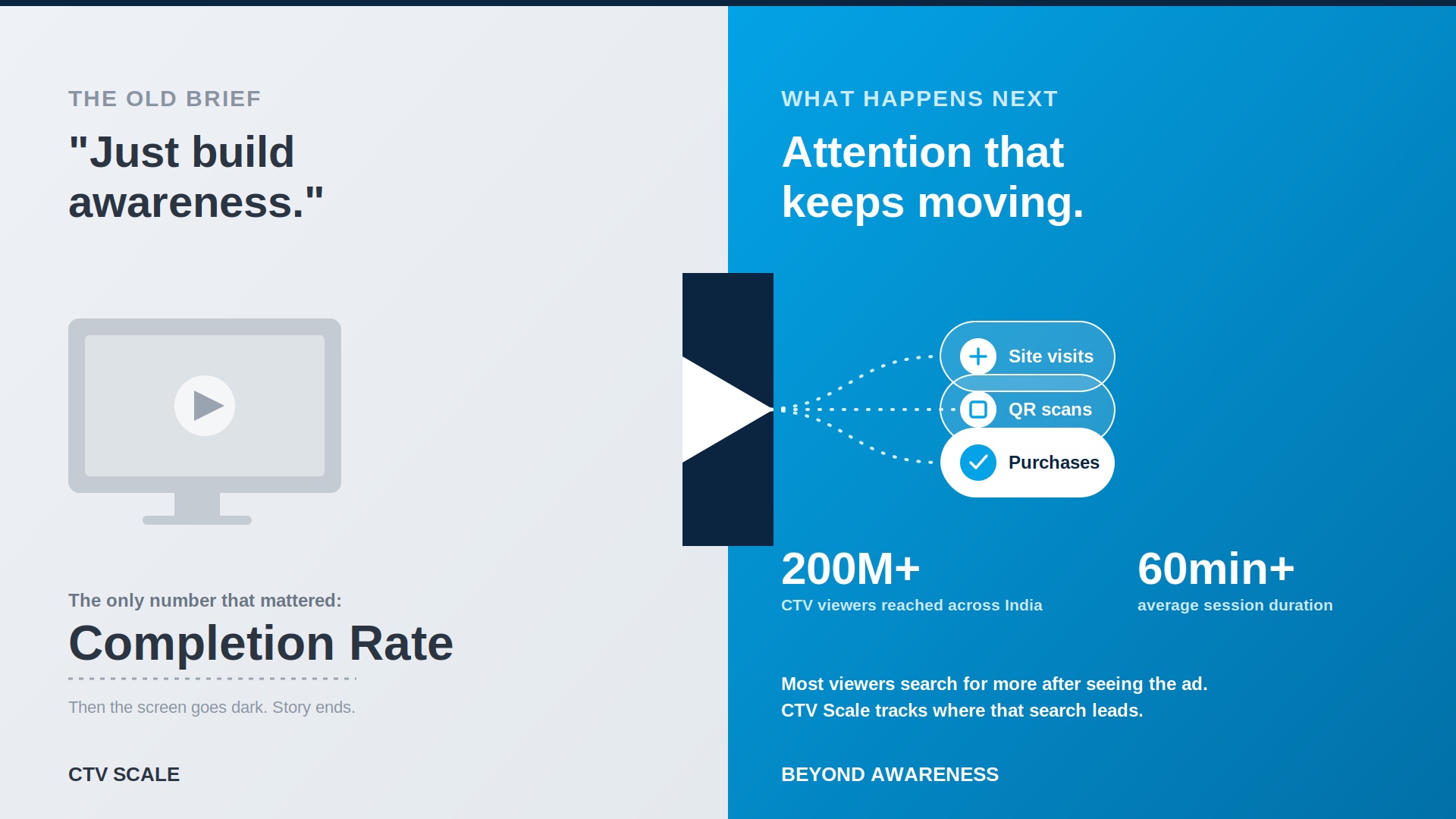
Connected TV has long been seen as a brand channel in media plans. A campaign would play on the screen, completion rates would look good, and that would be the end of the story. Most people assumed that CTV only built awareness while real business results came from search, social, and performance marketing. That assumption is very much just an assumption not the truth. Advertisers who still plan that way are missing a big part of the channel. The change shows in the numbers. CTV now reaches more than 200 million viewers in over 60 million households in India, almost three times the reach a few years ago. What matters more than size is what people do after seeing an ad. Recent research on Indian CTV viewers found that most viewers look for more information after seeing an ad, and the percentage is even higher among premium audiences. This is a channel where attention does not stop when the ad ends. Attention moves from the living room screen to the phone. Then into search, app stores, and storefronts. The reason CTV was hard to credit with business outcomes for long has less to do with the medium and more to do with measurement. A viewer s action after an ad usually does not happen on the device that showed the ad. Nobody clicks a television. The tools that link what people saw on their TV to what they did later have improved a lot, and deterministic attribution is now closing that gap. Advertisers using CTV Scale can track site visits, app installs, QR scans, and registrations back to campaigns. That means the channel can finally be judged on the same terms as any other performance line item while still keeping the scale and premium context that made it attractive. This changes what advertisers should ask for. A media plan that treats CTV as a reach vehicle reporting only video completion rate asks the channel to prove far less than it can. The useful question is what happens after the impression. Formats like pause ads and QR overlays give viewers a way to act while still watching instead of waiting for a later touchpoint. Shoppable formats shorten the gap between seeing a product on screen and thinking about buying it. Interactive and app sync capabilities let a single campaign report on outcomes from brand lift to app opens in the dashboard. None of this takes away the awareness value of the channel. It sits on top of it, turning one flight into a funnel tool instead of a single-stage tool. There is also an advantage that is underused. Average CTV session durations in India often last more than an hour, giving advertisers high‑attention windows in one sitting, not just one exposure to optimize. Brands that design a sequence taking a viewer from an opening story beat to a mid‑campaign moment to a closing conversion prompt tend to see stronger downstream results than brands that repeat the same thirty‑second film in every slot. Treating CTV as a canvas for a journey rather than a slot to fill is where the mid and lower funnel gains really come from. None of this means awareness stops mattering. Premium, large‑screen storytelling still does something that a six‑second mobile clip cannot copy, and category leaders will keep investing for good reason. What has changed is the ceiling. Advertisers, on CTV Scale, no longer need to choose between brand building and measurable outcomes because the same campaign, designed with intent, can deliver both. The advertisers who will get the most out of CTV in the coming year are the ones who stop asking whether the channel can perform and start asking what to measure once it does.

CTV vs Traditional TV Advertising: What Brands Need to Know?

CTV vs Traditional TV Advertising: What Brands Need to Know?

6/30/2026|By Sonal Bhardwaj

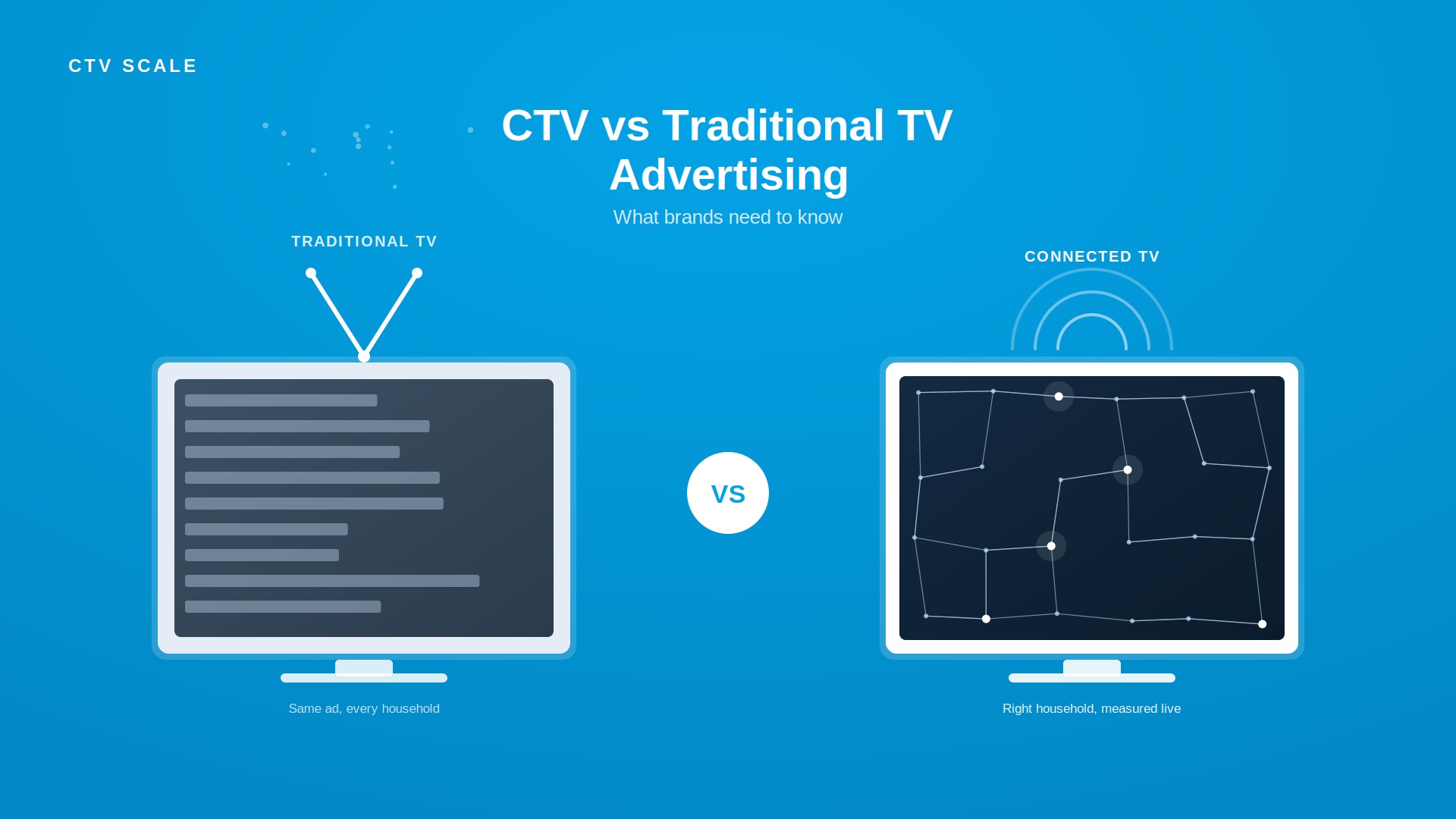
"CTV is not a departure from television advertising. It's television advertising finally living up to its full potential." Television has always been the most powerful advertising medium ever created. The big screen, the lean-back attention, the shared household moment, the storytelling canvas, nothing else comes close. Brands have known this for decades, and that is why TV has commanded the lion's share of premium advertising budgets for as long as most marketers can remember. So when people ask CTV vs. Traditional TV, what should brands know? The most honest answer is this: there is not really a versus. Connected TV is the same television you have always believed in, now running on smarter rails. Same screen. Same room. Same audience attention. Just with tools that were never available before. Think of it the way you had thought of any great upgrade. A printed map and GPS navigation both get you to the same destination. But one of them knows traffic, recalculates when you take a wrong turn, and learns your commute over time. CTV is GPS for television advertising. The Living Room has not changed. The Intelligence Behind It Has. The most important thing to understand about CTV is what has not changed. Viewers are still sitting on their sofas. The television is still the centrepiece of the living room. Families still gather around it. Ads still run in full-screen, with full audio, within professionally produced content environments. The brand-safe, premium, high-attention context that made TV advertising great? That's fully intact. What has changed is everything happening behind the scenes. Traditional linear TV broadcasts the same ad to every household watching a channel at the same time. It was powerful because of reach, and reach alone. CTV retains that reach and then layers on capabilities that were simply impossible in a broadcast world. CTV preserves every strength on which television advertising was built, while adding the precision and accountability that modern brands demand. The shift is not from TV to digital. It is from TV as a broadcast instrument to TV as an intelligent platform. Every CTV impression carries data. Every view tells a story. Every campaign becomes smarter in real time. And one should not take it as a threat to television's legacy because it's the fulfillment of it. What Intelligent Television Actually Looks Like When brands invest in CTV advertising, they are accessing the same premium inventory they always have, just with a new layer of intelligence built in. Audience Targeting, Not Just Channel Buying. Traditional TV buying meant purchasing time on a channel and trusting demographic averages. CTV lets advertisers define their audience precisely by age, interests, viewing behaviour, purchase intent, geography, and more, and reach them wherever they stream, regardless of the channel or platform. Real-Time Performance Measurement With linear TV, campaign performance arrived weeks after the fact through panel-based estimates. CTV delivers live dashboards: impressions served, completion rates, unique reach, cost per completed view, and downstream conversions. Brands know what is working while the campaign is still running. Frequency Management Across Screens One of linear TV's persistent blind spots was over-frequency, the same viewer seeing the same ad twelve times in a week. CTV solves this by tracking exposures at the individual level, capping frequency intelligently so every impression adds value rather than creating fatigue. Incremental Reach for Linear Campaigns Rather than replacing linear TV spend, CTV extends it. By identifying households that are underexposed or not reachable through traditional broadcast, CTV fills the gaps, reaching cord-cutters, streaming-first audiences, and younger demographics who are simply not present on linear TV anymore. Flexible Budget Control Premium television advertising once required large upfront commitments. CTV brings flexible, programmatic buying to the big screen, allowing brands of every size to access premium TV inventory with real-time budget control and performance-based optimisation. Television's Evolution, Not Its Replacement It helps to think of CTV not as a new medium but as the latest chapter in television's long evolution. Television itself has been evolving since its earliest days, from black and white to colour, from analogue to HD, from rabbit ears to cable boxes, from appointment viewing to DVR. Each evolution expanded what television could do for both viewers and brands. CTV is simply the next chapter. The internet has become the distribution layer for television content, and that connectivity has unlocked capabilities that were not technically possible with broadcast infrastructure. But the experience for the viewer and the opportunity for the advertiser remain fundamentally televisual. It's the big screen. It's the living room. It's full-sound, full-screen, premium storytelling. "The medium has not changed. The intelligence powering it has. That's the only distinction that matters for brands." TV's Core Strength How Linear TV Delivered It How CTV Elevates It Brand-safe, premium environment Professionally produced broadcast content Same premium content, plus verified brand safety at the impression level Massive reach National broadcast to millions simultaneously Reaches linear audiences plus cord-cutters and streaming-native households High-attention viewing Lean-back, living room environment Same environment, with data confirming completion rates above 95% Emotional storytelling 30- and 60-second narrative spots Same formats, with interactive and shoppable extensions available Audience targeting Demographic estimates via panels First- and third-party data at the individual household level Campaign measurement GRP-based post-campaign estimates Real-time dashboards with attribution, conversions, and incremental reach For Brands: This Is Still Television. Treat It Like Television. The practical implication for brand teams and media planners is straightforward: CTV deserves the same creative ambition, the same premium positioning, and the same strategic weight as any television campaign. Because it is a television campaign. Brands that have been cautious about shifting budgets toward streaming because it feels unfamiliar should reframe the question entirely. You are not moving your television budget to a digital channel. You are keeping your television budget on television, a smarter television that knows who is watching, measures every impression, and reaches the audiences that broadcast can no longer find. A great 30-second spot that builds brand emotion and tells a compelling story works on CTV exactly as it works on linear TV because it appears on the same screen, in the same living room, watched by the same type of engaged viewer. What CTV adds is the confidence of knowing your story reached the right person, at the right frequency, and the data to prove the impact. A Converged Future, Not a Fragmented One The smartest approach for brands today is not to choose between linear TV and CTV, it is to use them together as a unified television strategy. Linear TV provides the broad, simultaneous reach of a national broadcast moment. CTV extends that reach to the audiences linear can no longer touch, fills frequency gaps, and provides the measurement layer that makes the combined investment provably effective. This convergent approach is exactly what the CTV Scale is built to enable. By bringing together premium CTV inventory, data-driven audience targeting, real-time measurement, and seamless integration with linear TV campaigns, CTV Scale ensures that brands get the full power of television, not a fractured piece of it. Television did not stop being television when it moved to streaming. It got better at being television. The brands that recognise this earliest will be the ones who capture the attention of the audiences everyone else can no longer reach, and do it with the proof to show exactly what that attention was worth.

Common Mistakes Brands Make in CTV Advertising

Common Mistakes Brands Make in CTV Advertising

6/30/2026|By Sonal Bhardwaj

01 Repurposing TV spots without rethinking the format Dropping a 30-second linear TV commercial onto a CTV platform and calling it done is a trap. CTV viewers are engaged, but they are also one click away from skipping. Ads need to front-load the message, use clearer audio cues (many people watch without subtitles on), and work at smaller screen sizes. A broadcast spot optimized for a 65" living room TV rarely performs the same on a tablet or streaming device menu. 02 Ignoring frequency capping and wrecking the experience CTV's targeting precision is a double-edged sword. Without proper frequency caps, the same household sees the same ad six times in an evening. This does not just waste budget, it actively damages brand perception. Unlike social media, where a user can hide an ad, a CTV viewer is largely a captive audience. Annoyance compounds fast. Set household-level caps, not just device-level ones. 03 Buying inventory without understanding the supply chain CTV has a messy programmatic ecosystem. Brands routinely overpay for the same inventory purchased through multiple intermediaries, or worse, buy spoofed impressions posing as premium streaming. Auditing your supply path, prioritizing direct publisher deals or PMPs, and working with DSPs that offer supply-path optimization is not optional anymore, it's table stakes for efficient CTV buying. 04 Skipping creative testing Many brands run one creative for an entire CTV campaign and wonder why performance plateaus. Unlike traditional TV, CTV supports A/B testing at scale. Testing different hooks in the first five seconds, different calls to action, and even different voiceover tones can yield meaningful performance differences. Treating CTV as a "set it and forget it" channel leaves real gains behind. The brands winning on CTV right now are not necessarily spending more, but they are being more deliberate about every layer of the funnel, from supply chain to creative to measurement. The floor for good CTV advertising is higher than most brands think.